Investors Up in Arms After Mexico’s Government Clips Wings of Latin America’s Second Richest Man, Germán Larrea

The dirty “e” word — expropriation — is doing the rounds once again in Mexico, this time in relation to a highly strategic stretch of railroad in the country’s south east.

Life is getting harder for businesses in Mexico under its “unpredictable president,” Andrés Manuel Lopéz Obrador (aka AMLO). That is message of a recent Bloomberg piece. In recent days, the AMLO government has revoked a railroad concession belonging to Ferrosur, a subsidiary of Group Mexico, a huge mining and infrastructure conglomerate majority owned by Mexico’s second richest man, Germán Larrea. According to Bloomberg, it has also scuppered US lender Citi’s attempted sale of its Mexican subsidiary, Citibanamex, to, of all companies, Group Mexico.

The problems began on Friday May 19, when AMLO deployed marines to occupy three sections of railroad operated by Ferrosur in the south-eastern state of Veracruz. Officials described the measure as “temporary,” in the “public interest” and “relevant to national security.” The government also issued a decree identifying large infrastructure projects such as the Mayan train project as matters of national security. This comes on the heels of a raft of new mining reforms that could also affect the operations of some mining companies in Mexico, including Group Mexico.

Mexico’s Inter-Oceanic Corridor

The railroad is needed to complete an Inter-Oceanic Corridor on the Isthmus of Tehuantepec, a narrow stretch of land between the Gulf of Mexico and the Pacific Ocean. The $12.9 billion project is meant to help boost economic opportunities in Mexico’s poorer southern states as well as offer an alternative to the Panama Canal. Roughly 300 kilometres in length, it will link up Mexico’s Pacific and Atlantic coasts with both freight and passenger rail travel. The Corridor will include highways, three airports, ten industrial parks, a gas pipeline and a fibre-optic network. If completed, it will represent by far the most important infrastructure project of AMLO’s presidency.

AMLO justified his decision to revoke Ferrosur’s concession on three grounds:

  1. Group Mexico doesn’t own the railroad tracks, but rather has a concession to operate them. Private property can be legally expropriated, but “recovering a concession of the nation” is “very different,” AMLO said, even though his decree cited an expropriation law.
  2. That concession, which had been gifted by the Zedillo government as part of its privatisation drive in the late ’90s, can be revoked at any time.
  3. The government is considering paying “market-value compensation” to Group Mexico for the temporary occupation, but Larrea had demanded a payment of 9.5 billion pesos ($540 million), which AMLO described as “abusive.”

Needless to say, investors are not impressed.

“It’s not exactly inviting for the government to seize a railroad,” said Roger Horn, a senior strategist at SMBC Nikko Securities America in New York. “This is bizarre even for this administration, where AMLO has for the most part negotiated with the private sector to achieve his policy goals.”

It didn’t take long for the reverberations to spread. Two days after AMLO’s decree, US lender Citi announced it was cancelling its sale of its Mexican subsidiary, Citibanamex, to Grupo Mexico, the last remaining potential buyer for the 130-year-old bank. According to Bloomberg, the $7 billion deal fell through because Larrea had privately sought assurances that the banking sector wouldn’t become a target of AMLO’s interventions. When no guarantee was forthcoming, he decided not to move forward with the acquisition.

AMLO had already placed conditions on any deal for Banamex, including that it be backed by Mexican capital and that it does not lead to large-scale layoffs. This had the effect of reducing the pool of potential buyers.

It is also true — and this is something that much of the international media coverage conveniently leaves out — that a huge amount of uncertainty still hangs over the true size of Citibanamex’s liabilities as well as its ongoing litigation costs following numerous scandals, primarily involving the defunct shipping company Oceanografia (which we covered in January 2022). According to an article by Mexican news website La Silla Rota in February, the unresolved lawsuit had already shaved billions of dollars off Citibanamex’s value.

Now, Citi is stuck with little option but to activate plan B: to sell shares of its Banamex unit in an initial public offering. But that won’t happen until at least 2025. In the meantime, Citibanamex’s deposit base continues to shrink while its annual revenues for 2021, the last year for which Citi published results for the unit, were down by my more than half on where they were a decade ago.

AMLO himself has expressed an interest in the Mexican government taking a stake in the bank, saying he will urge Mexico’s finance minister to start talks over a possible public-private partnership with Citi. As for Larrea and Group Mexico, they are considering their options:

“Group Mexico Transportation continues to analyze the scope and effects of the [AMLO government’s] occupation decree, in order to determine which actions to take… If an agreement is not reached in the negotiation, the temporary occupation will ultimately lead to a deterioration of the company, its employees, customers, and the free market.

Little Sympathy for Larrea

Outside of Mexico’s investor class, Larrea’s troubles are unlikely to elicit much in the way of sympathy. After all, his company was responsible for Mexico’s worst ever mining disaster, the Buenavista Copper Mine toxic spill of 2014, as I reported at the time for WOLF STREET:

On August 6 the Buenavista del Cobre mine belonging to Larrea’s flagship company, Grupo Mexico, the country’s largest mining and infrastructure company, spewed 10 million gallons (40,000 cubic meters) of copper sulfate acid into the Sonora and Bacanuchi rivers, turning the waterways orange and poisoning the water supply of 24,000 people in seven communities along the rivers.

The fallout has been devastating. Even today, nine years after the disaster, thousands of people still have no access to fresh water or medical services; cases of illnesses — primarily respiratory and gastrointestinal disorders, skin conditions and high levels of heavy metals in the blood — have skyrocketed. Local farmers can no longer cultivate their land or sell their traditional products in the region, out of fear of contamination. Communities continue to demand justice, remediation, reparations, and assurances that this will never happen again.

Immediately after the spill Grupo Mexico was fined a measly $2 million. Through Mexico’s environmental agency SEMARNAT, the company was supposed to set up a trust fund of around 2 billion pesos (just over $100 million) to remediate the harm caused to local inhabitants and the environment. But many residents say they never saw a peso. A medical clinic was partially built and abandoned. Only two of 36 promised water purification plants are operating. A $307 million economic reactivation plan was never activated.

This is not the first time that Larrea had shown callous disregard for the occasionally destructive externalities of his line of business…

Read the full article on Naked Capitalism
Why Are US Military Personnel Heading to Peru?

The ostensible goal of the operation is to provide “support and assistance to the Special Operations of the Joint Command of the Armed Forces and National Police of Peru,” including in regions recently engulfed in violence.

Unbeknown, it seems, to most people in Peru and the US (considering the paucity of media coverage in both countries), US military personnel will soon be landing in Peru. The plenary session of Peru’s Congress last Thursday (May 18) authorised the entry of US troops onto Peruvian soil with the ostensible purpose of carrying out “cooperation activities” with Peru’s armed forces and national police. Passed with 70 votes in favour, 33 against and four abstentions, resolution 4766 stipulates that the troops are welcome to stay any time between June 1 and December 31, 2023.

The number of US soldiers involved has not been officially disclosed, at least as far as I can tell, though a recent statement by Mexico’s President Andrés Manuel Lopéz Obrador, who is currently person non grata in Peru, suggests it could be around 700. The cooperation and training activities will take place across a wide swathe of territory including Lima, Callao, Loreto, San Martín, Huánuco, Ucayali, Pasco, Junín, Huancavelica, Iquitos, Pucusana, Apurímac, Cusco and Ayacucho.

The last three regions, in the south of Peru, together with Arequipa and Puno, were the epicentre of huge political protests, strikes and road blocks from December to February after Peru’s elected President Pedro Castillo was toppled, imprisoned and replaced by his vice-president Dina Boluarte. The protesters’ demands included:

  • The release of Castillo
  • New elections
  • A national referendum on forming a Constitutional Assembly to replace Peru’s current constitution, which was imposed by former dictator Alberto Fujimori following his self-imposed coup of 1992

Brutal Crackdown on Protests

Needless to say, none of these demands have been met. Instead, Peru’s security forces, including 140,000 mobilised soldiers, unleashed a brutal crackdown that culminated in the deaths of approximately 70 people. A report released by international human rights organization Amnesty International in February drew the following assessment:

“Since the beginning of the massive protests in different areas of the country in December 2022, the Army and National Police of Peru (PNP) have unlawfully fired lethal weapons and used other less lethal weapons indiscriminately against the population, especially against Indigenous people and campesinos (rural farmworkers) during the repression of protests, constituting widespread attacks.”

As soon as possibly next week, an indeterminate number of US military personnel could be joining the fracas. According to the news website La Lupa, the purported goal of their visit is to provide “support and assistance to the Special Operations of the Joint Command of the Armed Forces and National Police of Peru” during two periods spanning a total of seven months: from June 1 to September 30, and from October 1 to December 30, 2023.

The secretary of the Commission for National Defence, Internal Order, Alternative Development and the Fight Against Drugs, Alfredo Azurín, was at pains to stress that there are no plans for the US to set up a military base in Peru and that the entry of US forces “will not affect national sovereignty.” Some opposition congressmen and women begged to differ, arguing that the entry of foreign forces does indeed pose a threat to national sovereignty. They also lambasted the government for passing the resolution without prior debate or consultation with the indigenous communities.

The de facto Boluarte government and Congress are treating the arrival of US troops as a perfectly routine event. And it is true that the US military has long held a presence in Peru. For example, in 2017, U.S. personnel took part in military exercises held jointly with Colombia, Peru and Brazil in the “triple borderland” of the Amazon region. Also, the US Navy operates a biosafety-level 3 biomedical research laboratory close to Lima as well as two other (biosafety-level 2) laboratories in Puerto Maldonado.

But the timing of the operation raising serious questions. After all, Peru is currently under the control of an unelected government that is heavily supported by Washington but overwhelmingly rejected by the Peruvian people. The crackdown on protests in the south of the Peru by the country’s security forces — the same security forces that US military personnel will soon be joining — has led to dozens of deaths. Peru’s Congress is refusing to call new elections in total defiance of public opinion. Just a few days ago, the country’s Supreme Court issued a ruling that some legal scholars have interpreted as essentially criminalising political protest.

As Peru’s civilian institutions fight among themselves, Peru’s armed forces — the last remaining “backbone” in the country, according to Mexican geopolitical analyst Alfredo Jalife — has taken firm control. And lest we forget, Peru is home to some of the very same minerals that the US military has identified as strategically important to US national security interests, including lithium. Also, as I noted in my June 22, 2021 piece, Is Another Military Coup Brewing in Peru, After Historic Electoral Victory for Leftist Candidate?, while Peru’s largest trading partner is China, its political institutions — like those of Colombia and Chile — remain tethered to US policy interests:

Together with Chile, it’s the only country in South America that was invited to join the Trans-Pacific Partnership, which was later renamed the Comprehensive and Progressive Agreement for Trans-Pacific Partnership after Donald Trump withdrew US participation.

Given as much, the rumours of another coup in Peru should hardly come as a surprise. Nor should the Biden administration’s recent appointment of a CIA veteran as US ambassador to Peru, as recently reported by Vijay Prashad and José Carlos Llerena Robles:

Her name is Lisa Kenna, a former adviser to former US Secretary of State Mike Pompeo, a nine-year veteran at the Central Intelligence Agency (CIA), and a US secretary of state official in Iraq. Just before the election, Ambassador Kenna released a video, in which she spoke of the close ties between the United States and Peru and of the need for a peaceful transition from one president to another.

It seems more than likely that Kenna played a direct role in the not-so-peaceful transition from President Castillo to de facto President Boluarte, having met with Peru’s then-Defence Minister Gustavo Bobbio Rosas on December 6, the day before Pedro Castillo was ousted, to tackle “issues of bilateral interest”.

On a Knife’s Edge

After decades of stumbling from crisis to crisis and government to government, Peru rests on a knife’s edge…

Read the full article on Naked Capitalism

Could Argentina Be the Next Latin American Country to Dollarise Its Economy?

As Argentina grapples with an unpayable debt load, triple-digit inflation, severe drought and rising economic hardship, the idea of abolishing the crumbling peso and adopting the US dollar gains ground.

There is a great deal riding on Argentina’s national elections in October. The reverberations will probably be felt across Latin America as the competition for strategic influence in the region as well as access to its coveted resources intensifies. China long displaced the US as Argentina’s largest trading partner, but the US is doing everything it can to regain lost ground, including, as we reported in January, rejigging the Monroe Doctrine, a 200-year old US foreign policy position that opposed European colonialism on the American continent:

It held that any intervention in the political affairs of the Americas by foreign powers was a potentially hostile act against the United States. Now, it is applying that doctrine to China and Russia.

Gen Richardson detailed how Washington, together with US Southern Command, is actively negotiating the sale of lithium in the lithium triangle to US companies through its web of embassies, with the goal of “box[ing] out” US adversaries.

The country where the US appears to be enjoying most success in this endeavour is Argentina, whose government even recently participated in the US-created Mineral Security Partnership, which Reuters dubbed a “metallic NATO”. But as the country grapples with unpayable debt, triple-digit inflation, severe drought and rising economic hardship, “Argentines are looking for a radical shift,” according to The Economist. The outcome of the upcoming election could even define the future of Argentina’s currency regime for years, if not decades, to come.

Dollarisation vs Dedollarisation

Much of the talk in recent months has been about dedollarising Argentina’s trade with China and Brazil, its two largest trading partners. In late April, the government announced it will start paying for Chinese imports in yuan rather than dollars. It activated the $18.5 billion million swap arrangement that same month, paying around $1 billion of its Chinese imports in yuan instead of dollars. As Reuters reported, the measure is intended to ease the country’s dwindling dollar reserves.

Argentina has been struggling with dollars for years, but this year its foreign currency reserves hit a critical low after a historic drought caused total agricultural losses of around €17.6 billion, or 3% of Argentine GDP. Dollar shortages are becoming an increasingly common problem among emerging market economies as central banks burn through their currency reserves in a desperate bid to stem the depreciation of their currencies.

Like 18 other emerging markets, Argentina has applied to join the BRICS-plus grouping, for which it can count on the full support of BRICS member Brazil. In fact, Brazil’s President Luiz Inácio Lula da Silva recently said he was conducting talks with fellow BRICS members Russia, China, India and South Africa about fining ways of helping Argentina’s economy. At the same time, Brazil and Argentina and discussing ways of reducing the influence of the US dollar in their bilateral trade. From Buenos Aires Herald:

Da Silva is attempting to persuade other BRICS leaders to have their economy ministers change an article in the group’s rules that would allow it to financially support non-BRICS countries such as Argentina through the New Development Bank, which is currently headed by his political ally and former Brazil president Dilma Rousseff.

On May 29, Da Silva will take part in a BRICS meeting where he expects to discuss the change. He said during the conference that he has spoken to Rousseff and also China’s President Xi Jing Ping about it.

Da Silva also vowed to continue working with Brazil’s Congress and exporters to Argentina to promote bilateral trade. This is likely to come in the form of credit for these companies to keep selling to Argentina and the development of mechanisms to trade in pesos and reais, skirting the U.S. dollar. Economy Ministers Sergio Massa and Fernando Haddad are expected to follow up on the work next week.

If the candidate chosen for the coalition of Peronist parties Frente de Todos — Alberto Fernández will not be running for a second term and two-time President Cristina Kirchner de Fernandez has also withdrawn from the race — emerges triumphant in November, it is safe to assume that the resulting government will continue to pursue BRICS membership, dedollarisation and the expansion of bilateral trade with both China and Brazil, its two largest trading partners. As the Argentinean broadcaster TN recently reported, China’s consolidation as Argentina’s number-one trading partner is a growing source of consternation for both the US and Europe:

The US and EU’s greatest fear is not only that China becomes the main trading partner but that, with that status, it will be able to influence bids and gain control of strategic sectors in Argentina such as telecommunications, ports, routes, military inputs and energy.

The two other main challengers in October’s election are Together for Change, a pro-US liberal-conservative bloc that helped propel Mauricio Macri to the presidency in 2015 but which is yet to choose a candidate; and Freedom Advances, a grouping run by the libertarian economist and congressman Javier “the Wig” Milei that paints itself as fiercely anti-communist and the last bastion of economic freedom in Argentina, and is currently leading in the (notoriously unreliable) polls. Given the prevailing economic uncertainty and despair in the country, with inflation surging to a record 109% year-over year in April, Milei has found fertile ground for his eclectic mix of right wing demagoguery and hair-brained economic policy proposals.

Those proposals range from classic neoliberal fare (charging poor people for public healthcare, cutting retirements and pensions, removing currency controls and “taking a chainsaw to public spending”) to more extreme measures that one Argentinean economist described as “proposed by fanatics that think it’s best to blow everything up”. They include shutting down Argentina’s central bank, abolishing the Argentine peso and adopting the US dollar as the official currency).

“If you want to end the scam of monetary emission to cover for the treasury and end inflation, given that Argentine politicians are thieves, the only way is to close down the Central Bank and, at the beginning [of my government], dollarize [the economy],” Milei tweeted last month.

A Popular Idea Among Some

The idea enjoys strong support among certain US economists. They include Johns Hopkins Prof Steve Hanke, who once served as adviser to the government of President Carlos Menem whose decision in the early ’90s to fix the Argentine peso at a wholly artificial and unsustainable value of one U.S. dollar paved the way to the financial crisis and currency devaluation of 2001, from which Argentina’s economy has never been able to properly recover…

Read the full article on Naked Capitalism

EU Adopts “Pragmatic Approach” To Sharing Its Citizens’ Most Precious Data With US Department of Homeland Security

“The EU’s own top court has ruled on multiple occasions that the USA does not offer adequate privacy protections for non-citizens, yet the Commission and the member states are planning to open up their biometric databases to the [DHS].”

This post is based largely on the findings of a report that was released in late April by the British civil rights organization Statewatch. That was some time ago, but given the pertinence of the topic to citizens on both sides of the North Atlantic as well as the paucity of coverage in both the mainstream and alternative media, I thought it merited a belated post.

An Offer Most Governments Probably Won’t Refuse

First some background. As readers may recall, the Biden administration last year quietly made an offer to roughly 40 governments in Europe, the Anglosphere and beyond that they will probably be unable to refuse. That offer was to grant them access to vast reams of sensitive data on US citizens held by the Department of Homeland Security. From my July 26, 2022 post, Unbeknown to Most US Citizens, Washington is Preparing to Share Their Biometric Data With Dozens of Other National Governments:

 [The data repositories] include the IDENT/HART database, which… Statewatch describes as “the largest U.S. Government biometric database and the second largest biometric database in the world, containing over 270 million identities from over 40 U.S. agencies.”

Biometric identifiers include fingerprints, facial features and other physiological characteristics that can be used for automated identification. In some cases, these identifiers have been harvested by the US government without the consent of the citizens in question.

Granted, biometric technologies are already being used in diverse settings, from banks (a topic Yves recently broached in Banks Try to Make Security Customer-Friendly. Not a Good Mix) and other financial institutions to schools and workplaces. Passports around the world have included biometric features for many years, as have other forms of ID. Many people choose to sign in to their mobile phones and tablets using their biometric data.

Nonetheless, DHS’ data-sharing proposal is worrying for a host of reasons. For a start, the wholesale collection and sharing of biometric data is problematic because the data is irreplaceable. Once it is compromised, there is no way of undoing the damage. You cannot change or cancel your iris, fingerprint or DNA, like you can change a password or cancel a credit card. It is also prone to biases as well as failure, whether due to the fading of fingerprints or cataracts affecting iris scans. What’s more, the systems upon which the data are stored are far from impregnable.

“The idea of a data breach is not a question of if, it’s a question of when,” says Professor Sandra Wachter, a data ethics expert at the Oxford Internet Institute. “Welcome to the Internet: everything is hackable.”

And so it has proven. In 2020, hackers supposedly working for the Russian government gained access to internal communications within DHS. As Jerri-Lynn Scofield reported for NC in 2017, the world’s largest biometric ID database, India’s Aadhaar system, has been repeatedly hacked. Documents published by Wikileaks suggest that the CIA used tech provider Cross Match Technologies to discreetly extract Aadhaar data. As Wikileaks noted on its website, the CIA already has a branch, known as the Office of Technical Services (OTS), that is devoted to collecting and sharing biometric data with liaison services around the world, “[b]ut this ‘voluntary sharing’ obviously does not work or is considered insufficient by the CIA.”

Now, the US wants to formalize its collection of biometric data beyond US borders. Its data-sharing arrangement is being offered to all 40 countries selected for the US government’s Visa Waiver Program (VWP). That means their citizens can travel to the U.S. for up to 90 days without a visa. They include most of the EU’s 27 Member States, three of the US’ four fellow members of the Five Eye Alliance (United Kingdom, New Zealand and Australia), Japan, Israel and South Korea.

The first countries to be approached were reportedly the EU, the UK and Israel (though Israel is not actually a VWP member). Of course, the US government is not doing this out of selfless altruism. On the contrary, it expects the governments of the VWP member countries to make their own citizens’ biometric data available to the US Department of Homeland Security as part of what the US calls “Enhanced Border Security Partnerships (EBSPs).” Back to my last piece:

“…DHS may submit biometrics to IBIS partner countries to search against their biometric identity management systems in order for partner countries to provide DHS with sharable biographic, derogatory, and encounter information when a U.S. search matches their biometric records. This high-volume matching and data exchange is accomplished within minutes and is fully automated; match confirmation and supporting data is exchanged with no officer intervention.

The emphasis in the last sentence was added by Statewatch, for good reason. In the fully digitised world that is fast taking shape around us, many of the decisions or actions taken by local, regional or national authorities that affect us will be fully automated; no human intervention will be needed. That means that trying to get those decisions or actions reversed or overturned is likely to be a Kafkaesque nightmare.

Participation in the EBSPs will be mandatory for VWP member states if they want their citizens to continue to benefit from visa-free travel to the US. Any country that refuses will probably find their eligibility for the Visa Waiver Program withdrawn. A Department of Homeland Security (DHS) document published by Statewatch last year showed that the EBSPs will require “direct connections between the biometric databases of participating states and the USA’s IDENT/HART system.”

“Continuous and Systematic” Transfers of Data

Statewatch recently came out with a second report detailing the latest developments in this quietly evolving story. It features excerpts from a Council of the EU document obtained by Statewatch. They include an admission from the Council that the EBSPs will involve “continuous and systematic” transfers of biometric data to the USA for the sake of immigration and asylum vetting. The Commission and the Biden administration set up a “dedicated Working Group” last September to hash out the EBSP requirements.

Ominously, the document notes that “the Commission has recently opted for a pragmatic approach, that is to disassociate information exchange from issues linked to visa policy,”  when EU member states engage with the U.S. on “bilateral negotiations.”

In other words, the Commission will look the other way if EU member states decide to begin sharing their citizens’ biometric data with the DHS. It has even told member states that they can negotiate an EBSP bilaterally with the USA as long as those discussions cover “information exchange only, and not the EU’s common policy on visa.” At the same time, it notes that “considering the continuous and systematic transfers envisaged by the U.S.,” negotiations should be based on “an international agreement or administrative arrangement ensuring sufficient data protection safeguards.”

Of course, the Commission knows better than anyone that the US does not have sufficiently strong data protection safeguards in place. The Court of Justice of the European Union (CJEU) has twice ruled against the Commission’s proposed data sharing arrangements with the US for failing to comply with the EU’s General Data Protection Regulation (GDPR). Although GDPR may be flawed, it is, as Cory Doctorow commented on this site just over a year ago, “the most comprehensive (and, sadly, underenforced) data-protection law on Earth.” While the US may have made some concessions on data protection in recent years, it still has a long way to go…

Read the full article on Naked Capitalism

US Corn Industry Faces Tough Times In Its Two Largest Export Markets, China and Mexico

After Russia’s invasion of Ukraine, China has sought new suppliers, including fellow BRICS members Brazil and South Africa, to reduce its dependence on US producers, while Mexico is determined to push through with its partial ban on GM corn.

The United States Department of Agriculture is projecting record bumper crops for both corn and soybeans in 2023. Domestic corn production is estimated to reach 15.265 billion bushels, up 1.535 billion on 2022’s record harvest, largely due to increased planted area. But as supply surges, US corn growers face the prospect of slumping demand in its second biggest export market, China, as well as stiffening regulatory challenges in Mexico, its largest market. Between them China and Mexico accounted for just over half of all overseas purchases of US corn in the last crop marketing year (Sept. 1 2021- Aug. 31 2022).

China Scrambles to Diversify Its Corn Supplies

China has been gradually reducing its corn imports from the US due to a combination of weak domestic demand and cheaper supplies from Brazil. Until recently, China imported roughly 70% of its corn from the US and roughly 30% from Ukraine, according to Brazilian grain exporters group Anec. But after Russia’s invasion of Ukraine, Beijing has, unsurprisingly, tried to find new suppliers to reduce its dependence on US and Ukrainian producers. Two of the countries it has turned to are fellow BRICS members Brazil and South Africa, Africa’s largest corn grower.

The results are already being felt. As Reuters reported in early May, Chinese buyers cancelled  832,000 tons of orders in the last three weeks of April alone. That was enough to push US corn exports to their lowest weekly total on record.

“China has made a strategic decision that rather than deal with the United States and our political differences, they will just buy from Brazil,” said Jim Gerlach, president of broker A/C Trading in Indiana.

Brazil is not only providing China with cheaper corn but is on track to overtake the US as the world’s largest corn exporter this year. From Bloomberg:

Increased competition from Brazil is underscored by forecasts for it to pass the US as the top exporter this year.

China went on a corn buying spree in March, with purchases of almost 4 million tons announced by the US government between March 14 and April 14. But US corn is now less competitive, with supplies from Brazil about $30 a ton cheaper for delivery in the third quarter, traders said. Weak domestic demand for corn as animal feed is also a reason behind the cancellations.

Another reason China has been cancelling orders is that it also anticipates a bumper corn crop this year. Farmers in the northeast, the top production region for corn and soybeans, have been more inclined to grow corn due to higher profits and easier management, CITIC Futures said. But increasing competition from Brazil is also taking its toll. Last year, China was already the destination of 1.16 million tonnes of corn from Brazil, almost all of which was shipped in December.

Preparing for Further Fallout from US-China Trade Wars

Despite the increase in domestic corn production, China is forecast to import 20 million tonnes this year, according to Anec. How much of that will come from the US remains to be seen. Many US farmers are already fretting about the risk of further fallout from the escalating US-China trade wars. Soybeans farmers already lost in excess of $25 billion worth of agricultural exports to retaliatory tariffs a few years ago, as S&P Global noted in a market report last August.

“We [US farmers] somehow managed to pull through the last trade spat with China, but afterwards, we did lose some of the market share to Brazil,” said an Illinous-based soybeans farmer.

“Another round of trade restrictions from China could see us losing a significant volume of sales, which we can ill afford,” another farmer said.

So, the question is: are US farmers’ concerns justified?

Data doesn’t lie. The fact remains that China is the biggest market for American farmers. The world’s second-largest economy with a 1.4 billion population consumes roughly a fifth of US agricultural exports every year.

In fact, China is almost indispensable for American agriculture, especially soybeans and corn. In 2021, 52% of the US soybean shipments of 53 million mt were sold to China, according to the US Department of Agriculture. China also purchased 27% of 69 million mt of exported corn last year.

The second biggest buyer of US corn is Mexico, which bought $4.92 billion of the (largely) yellow foodstuff in 2022. Together, the two countries account for well over half of all foreign purchases of US corn as well as roughly 60% of US soybeans and 34% of all US agricultural exports. Like Beijing, Mexico is now shopping around for alternative suppliers of corn, its number-one staple food, albeit for different reasons.

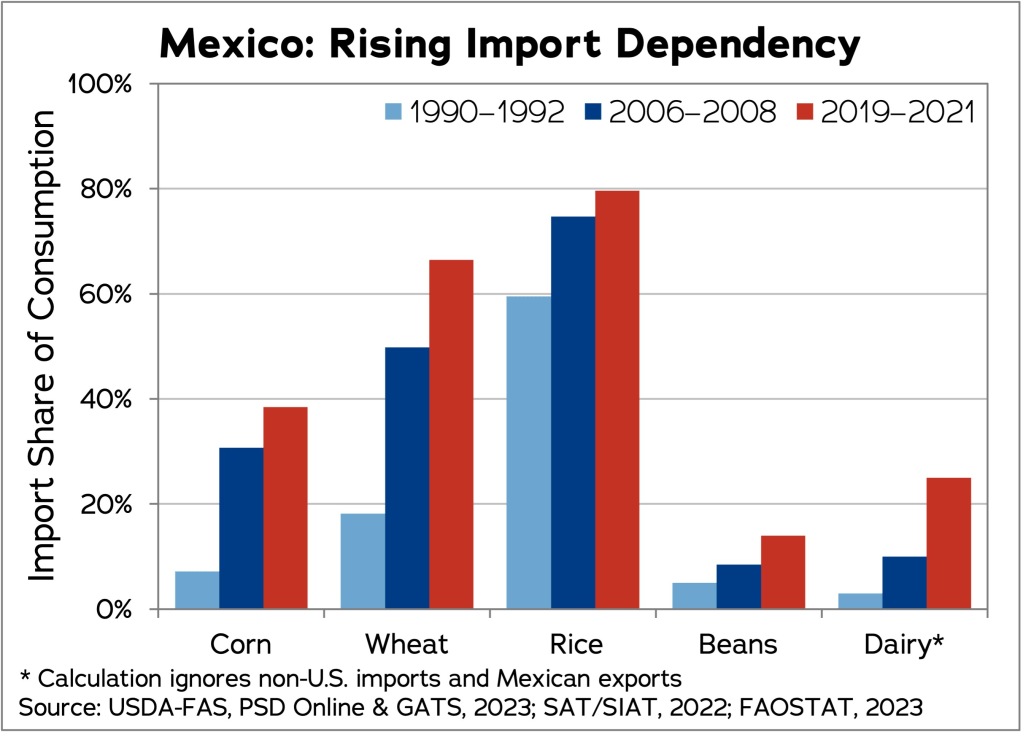
As regular readers know, what Mexico wants is to grow its own non-generically modified corn and import only non-GM corn to meet domestic demand for human consumption. And almost all the corn the US exports is genetically modified. The Mexican government’s reasons for doing so include protecting the health of the population, the environment and Mexico’s bewildering genetic diversity of maize. The government also wants to halt and ultimately reverse its acute — and growing — dependency on US imports for all of its main food staples, as illustrated in this graph:

Source: Timothy A Wise

As I have noted before, Mexico’s dependency on US staples is largely the result of NAFTA, which eliminated the Mexican government’s protection mechanisms for Mexican farmers while preserving U.S. corn subsidies for US farmers and Big Ag corporations. Two years after NAFTA, the Clinton Administration’s Farm Bill dismantled the last vestiges of U.S. government policies designed to boost prices by limiting overproduction.

The result was as predictable as it was brutal: the US flooded Mexico with staple foods at prices Mexican growers could not possibly compete with, forcing many of them out of business while discouraging others from trying to expand production. According to the Institute for Agriculture and Trade Policy (IATP), in 16 of the 28 years since NAFTA took effect, the U.S. exported corn, soybeans, wheat, rice and cotton at prices 5-40% below what it cost to produce them.

Reversing the Trend

Mexico’s President Andrés Manual Lopéz Obrador (aka AMLO) is determined to reverse this trend by reducing Mexico’s dependence on imported foods, though he faces an uphill challenge in actually pulling it off…

Read the full article on Naked Capitalism

One of the Few South American Governments Still Closely Aligned With Washington Just Signed a Trade Agreement With China

China continues to pull off big commercial and diplomatic coups in the US’ direct neighbourhood — this time with Ecuador, whose government is so closely aligned with the US that it recently asked Washington to directly intervene in its drug wars.

Yesterday (May 11), Ecuador became the latest in a series of Latin American countries to sign a free trade agreement with China. Beijing has already signed deals with Chile, Peru and Costa Rica, and is negotiating future agreements with at least five other Latin American states, including Uruguay, Honduras and El Salvador. As I reported last week, it is also taking advantage of the US’ near-shoring strategy by increasing its presence in Mexico.

The latest deal was signed by Ecuador’s Minister of Trade, Production, Investment and Fisheries, Julio Prado, and Chinese’s Trade Minister, Wan Wentao, after roughly a year of negotiations. The event was also attended by Ecuador’s embattled President Guillermo Lasso whose government is closely aligned with US, Ecuador’s largest trading partner, on most issues, particularly those pertaining to security.

But China is Ecuador’s second largest trading partner as well as its largest bilateral creditor and a major investor and participant in its energy and infrastructure sectors. In 2022, trade between the two countries witnessed double-digit growth for the second year in a row, with bilateral trade reaching $13.1 billion, up 19.7% year on year. Once the FTA comes into effect, as much as 90% of the goods traded between China and Ecuador will be exempted from tariffs. To protect Ecuadorian manufacturers, they will not include Chinese textiles and clothing, school shoes, flat ceramics, tires, furniture, sugar, rice , milk, potatoes and corn.

“This is an opportunity to further expand cooperation,” Wang Wentao said via video conference.

Beijing has been Ecuador’s main source of external finance for over a decade, a trend that dates back to former President Rafael Correa’s deepening of ties with China during his time in office (2007-17) as well as Ecuador’s virtual exclusion from Western sovereign credit markets in 2008 after Correa’s government defaulted on sovereign bonds deemed to be riddled with irregularities.  Beijing was happy to fill the gap. According to the FT, Ecuador owes China around US$18 billion.

The economic partnership between the two countries intensified after they signed a memorandum of understanding in 2018, explained the Chinese Ambassador to Ecuador, Chen Guoyou, in February:

Chinese enterprises have actively participated in the development of local infrastructure such as electricity, transportation, petroleum, and mining, and strategic areas such as oil and mining, as well as the construction of hospitals, housing, schools, and other infrastructure projects…

At the end of 2018, the Chinese and Ecuadorian governments signed a Memorandum of Understanding on the joint construction of the BRI, which has further deepened the pragmatic cooperation between the two sides in various fields. Looking to the future, we look forward to further deepening cooperation in traditional areas such as trade, investment, and financing, as well as infrastructure, continuously expanding exchanges and cooperation in emerging areas such as 5G and new energy.

Debt for Nature?

This development is interesting for a number of reasons. First, Ecuador was one of the first countries in the world to default on Chinese bonds, which it did in April, 2020, under the presidency of Lenin Moreno, Correa’s successor who infamously handed over Julian Assange to the British police allegedly in exchange for a $4.2 billion loan from the International Monetary Fund, to which the U.S. is the largest contributor. In September 2022, Lasso’s government reached an agreement with Chinese lenders to restructure some $3 billion of debt.

In other words, China is perhaps a somewhat more forgiving creditor than Western governments have given it credit for in recent years. But some researchers and NGOs have also called on China to swap some of Quito’s debt for commitments to preserve Ecuador’s rich biodiversity in what is commonly called a “debt-for-nature swap”.  Debt-for-nature swaps are typically a voluntary transaction in which an amount of debt owed by a financially distressed government of a country rich in biodiversity is cancelled or reduced by a creditor, in exchange for the debtor making financial commitments to conservation.

Debt-for-nature swaps first came to the fore in the late 1970s and early 1980s, as a domino chain of Latin American countries defaulted on sovereign debt in what came to be known as the “lost decade” for the region, but have waned since the 1990s. They now appear to be making a comeback after the COVID-19 pandemic and subsequent lockdowns plunged many of the region’s 33 countries back into unsustainable levels of indebtedness…

Read the full article on Naked Capitalism

EU Commission’s Flagship Annual Economic Event Just Showed How Little Public Appetite There Is for Cashless Economy

Even at the very heart of the EU’s political establishment, a majority of people believe that a cashless society would not be beneficial for the general public or the economy.

Few organizations have tried as hard to curtail the public’s use of cash as the European Commission. A few years ago it was considering imposing EU-wide cash payment restrictions but ended up shelving the plan in 2018 after a public backlash. A year earlier, 95% of respondents to a public consultation run by the Commission, many from cash-loving Germany and Austria, had said they were opposed to the idea. Even more emphatic was the answer to the following question:

“How would the introduction of restrictions on payments in cash at EU level benefit you, or your business or your organisation (multiple replies are possible)?”

In the curious absence of an explicit “not at all” option, 99.18% chose to respond with “no answer.” In other words, less than 1% of the more than 30,000 people consulted could think of a single benefit of the EU unleashing cross-regional cash limits. In the end, the Commission concluded that “limiting cash would not prevent the financing of terrorism and would be considered a violation of the personal freedom of Europeans.”

But it did not end its war on cash. While the Commission may have pressed the pause button on its campaign against physical money within the EU, it was rapidly escalating its actions at the EU’s borders. As I reported for WOLF STREET at the time, the Commission had proposed a raft of measures to tighten cash controls on people entering or leaving the EU, most of which were eventually ratified by EU Member States and the EU parliament.

Since then many national governments have taken up the baton. Spain and France have imposed some of the lowest cash payment limits in the EU, each of just €1000, though in the case of France the rule does not apply to everyone: well-heeled non-residents can spend as much as €15,000 in cash transactions. In Belgium, there has been a limit of €3,000 since 2014, while in Greece the cash ceiling is €1,500. More recently, the Commission took umbrage at the Meloni government’s proposals to lift Italy’s cash payment limit from $2,000 to €5,000 and repeal punitive measures for retailers who refuse to take card payments, arguing that they will weaken Italy’s ability to fight tax evasion.

Little Love for Physical Money

In other words, the European Commission has little love for physical money. Which is why it came as somewhat of a surprise to see that it had included an Oxford-style debate on the pros and cons of a cashless economy at its annual economic event, the Brussels Economic Forum, held last Thursday at the Brussels Convention Centre. The motion under debate was:

“This forum believes that a cashless society would be beneficial for people and the economy.”

Speaking in favour of the motion was Cecilia Skingsley, head of the Innovation Hub at the Bank for International Settlements, the central bank of central banks, and former deputy governor of Riksbank, Sweden’s central bank. Speaking against was Brett Scott, a financial journalist and author of the book Cloud Money: Cash, Cards, Crypto and the War for Our Wallets.

Things got pretty interesting from the get-go. Before the speakers spoke, the event’s attendees were invited to vote on the resolution. A slim majority (52%) voted against the motion while 48% voted in favour. In other words, even at the heart of the EU’s political establishment, at the EU executive’s flagship economic conference, most people believe that a cashless society would not be beneficial for the general public or the economy.

Then the debate began. First to speak was Skingsley, who gave a rather weak defence of the motion, describing cash as “no longer fit for purpose given the technical changes we observe around us.” For a start, she said, cash does not promote access to financial services beyond people’s “most basic needs.” In other words, people who only use cash are cut off from “the services being offered by the financial system: they don’t have access to credit, to safe savings products or insurance, and they can only use the most basic credit services.”

This was the essential thrust of Skingsley’s argument: people who only use cash because they have no other options are condemned to eke out a finance-free existence where they have to pay more for credit and other financial services. It doesn’t seem to occur to her that the main cause of this problem is accessibility (or the lack thereof) to financial services for certain segments of the population rather than the ubiquity of cash. Indeed, if it weren’t for the widespread availability of cash the so-called “unbanked” would have no means of payment at all.

Anonymity a “Two-Edged Sword”

She also described anonymity as a “two-edged” sword:

It has a major shortcoming. It means that others don’t know who you are and they can’t figure: are you a good payer, can you handle a saving (sic), can you carry a loan?

Presumably by “a saving,” Skinsgley means “a savings account”. By “others”, she appears to be referring once again to banks and other financial services companies, which are currently in the dark about the creditworthiness of unbanked citizens. Again, most of the emphasis is on the potential benefits of a cashless economy for financial services providers as opposed to their actual users. In fact, Skingsley rarely mentions the benefits of a cashless society for everyday citizens, presumably because those benefits barely extend beyond a few minor gains in time and convenience as well as the ability to access financial products, with all the benefits and risks that entails.

Ultimately, most of the benefits of a cashless economy will accrue to the financial and tech companies for whom cash is a major competitor. These companies talk all the time about the social benefits of “financial inclusion” but as a recent article by the Committee for the Abolition of Illegitimate Debt (CADTM) notes, their ultimate goal in expanding digital financial services to the world’s unbanked while undermining cash is to “recruit as many new clients as possible, the better to be able to quietly extract a never-ending stream of value from intermediating their trillions of dollars’ worth of tiny financial transactions.”

Skingsgley also dedicated a large part of her talk to trying (and largely failing) to assuage fears about the potential dangers of a cashless society. These, she said, include the public’s fears around big tech and financial companies erecting a “big brother” society. Her answer to that problem is to give more powers to government (as in, EU) entities to use their legislative, regulatory and supervisory powers to ensure they can’t.

The problem here is that many government agencies are already captured by the financial and tech companies…

Read the full article on Naked Capitalism

UN Development Program Believes Ukraine’s Digital ID and Governance Platform Is Ready to “Go International”

Ukraine is “building the most convenient digital state in the world — without corruption, without bureaucracy, absolutely paperless, and open for everyone.” And the UNDP, like USAID, is fully on board.

Through its “Diia” digital ID and governance platform, launched in February 2020, the Zelensky government seeks to create a system that will make Ukraine the most “convenient” State in the world. This is what Ukraine’s Minister of Digital Transformation and Deputy Prime Minister Mykhailo Fedorov told participants of the 2021 edition of the WEF’s Young Global Leaders program, of which he is an alumnus. He is also a graduate of the NATO Educational School in Kiev.

Diia is today used by close to 19 million Ukrainians and has nine digital credentials on its platform: the national ID card, the identity provider (IDP) certificate for network access, birth certificate, passport, driving license, tax number, student card, and vehicle registration certificate.

Accelerating Ukraine’s Digital Transformation, Even During War

Ukraine’s Diia system was recently the subject of a gushing article by the United Nations Development Program. Titled “The World is Very Turbulent, and You Adapt,” the article lays out how Ukraine is accelerating its digital transformation, even during war:

Despite being plunged into war, Ukraine is forging ahead with a comprehensive re-think of how business is conducted, and how Ukrainian people interact with each other and with their government.

“We are building the most convenient digital state in the world — without corruption, without bureaucracy, absolutely paperless, and open for everyone,” Ms. Ionan [Ukraine’s Deputy Minister of Digital Transformation] says.

The online portal and a mobile application for public services is called Diia, which is Ukrainian for ‘action’.

It aims to move all public services online, cover the entire country with internet access, close the gender and generational gaps in digital literacy, and make Ukraine the most welcoming country in the world for IT companies.

The claim that Ukraine’s digitised system of governance will transform the country from one which until recently (i.e., before the war) was widely spoken about as one of the most corrupt in Europe into one where corruption ceases to exist is altogether, of course, risible. So, too, is the notion that an “absolutely paperless” bureaucracy is somehow a desirable outcome despite all the inherent security risks. Also, the idea that Ukraine will become the most welcoming country in the world for big tech companies once the Russian bombs have stopped falling seems a little far-fetched. For a start, it assumes that the West will retain significant control of Ukraine once the dust from the war has settled.

That’s not to say that Silicon Valley big tech companies and large financial institutions are not heavily involved in Ukraine’s Diia project. After all, the purpose of Diia is not just to digitize public services but to automate, outsource and privatise them, as Fedorov told the WEF’s 2021 class of Young Global Leaders:

The Government needs to become as flexible and mobile as an IT company, to automate all functions and services, significantly change the structure, reduce 60% of officials, introduce large-scale privatization and outsourcing of government functions.

The government has been true to its word. Ukraine’s e-banking system is predicated on a Memorandum of Understanding with Visa while an electronic census is run by Apple. Amazon Web Services used its AWS Snowball — a petabyte-scale data transport service that uses secure devices to transfer data into and out of the AWS Cloud — to help Kiev migrate huge troves of data from multiple ministries to Poland in the early days of the war, picking up a Ukrainian peace prize in the process. Meanwhile, Google is effectively running large parts of Diia, as Fedorov proudly admitted last December:

“Google services have become our infrastructure. The tools provided by the company allowed the Government to function quickly and efficiently despite the shelling and constant threats of cyber attacks. In addition, Google ensures protection and security of Ukrainians’ data and promotes development of our entrepreneurs. On the other hand, the company pays great attention to human capital. In particular, it supports the initiatives of the Diia Digital Education project.

“State in a Smartphone”

In its article, the UNDP does not raise a single concern about the Zelensky government’s “State in a Smartphone” model of digital governance, which includes plans to hold local, parliamentary and presidential elections through the Diia app — an idea that was endorsed way back in February 2020 by Washington-based think tank the Atlantic Council as a means of “greatly reduc[ing] the scope for electoral fraud” in the country.

Yet just two months later the American Association of the Advancement of Science issued an open letter to US governors, secretaries of state and electoral boards urging them “to refrain from allowing the use of any internet voting system” warning of possible vote manipulation and numerous security vulnerabilities, “including potential denial of service attacks, malware intrusions, and mass privacy violations, remain possible in internet voting.”

A group of Ukrainian cybersecurity analysts have flagged a host of other concerns including Diia’s potential for use in frauds and scams; the lack of an account disabling option; its exclusionary effects (some citizens cannot afford or do not know how to use the Diia app); its dependence on an Internet connection and a functioning electricity grid (currently not the case in Ukraine, or for the foreseeable future); and the lack of transparency and accountability of the organizations running the app. The app also creates an excessively centralized form of governance as well as a highly automated system of social and economic control and exclusion.

As the even the World Economic Forum, one of the world’s biggest supporters of digital IDs, admitted in a 2018 report, while verifiable digital identities “create new markets and business lines” for companies, especially those in the tech industry that help to operate the ID systems while no doubt vacuuming up the data, for individuals they (emphasis my own) “open up (or close off) the digital world with its jobs, political activities, education, financial services, healthcare and more.”

None of these concerns get a mention in the UNDP article, however…

Chinese Companies Are Taking Advantage of United States’ Nearshoring Strategy By Setting up Shop in Mexico

Although China accounts for only a small fraction of Mexico’s total Foreign Direct Investment, it has significantly expanded its portfolio in recent years.

Chinese companies are taking an increasing interest in setting up or expanding their operations in Mexico, as Washington escalates its trade war with Beijing. In 2022, Chinese foreign direct investment (FDI) in Mexico soared by 48% year over year, from $1.7 billion to $2.5 billion [1], according to the Monitor of Chinese Outbound Foreign Direct Investment (OFDI) in Latin America and the Caribbean 2023, published last week by the Center for China-Mexico Studies (Cechimex) at the National Autonomous University of Mexico.

This contrasts with a 6.7% annual drop in Chinese FDI across Latin America as a whole. Although China accounts for only a small fraction of Mexico’s total FDI (roughly 7% in 2022 based on LAC-China Network’s numbers, compared to the US’ 43%), it has significantly expanded its portfolio in recent years and is the fastest growing source of foreign investment in Mexico.

An Interesting But Delicate Position

The report indicates that Mexico has the third largest Chinese FDI footprint in the region, behind China’s fellow BRICS partner Brazil ($5.7 billion) and Argentina ($2.94 billion). This puts Mexico in an interesting — and somewhat delicate — position.

On the one hand, its economy is benefiting handsomely from North America’s nearshoring trend, which is seeing a wave of global companies relocate some or all of their operations from China and other parts of Asia to Mexico in order to serve the US market. Last year, it attracted $35.3 billion in FDI, its highest level since 2015. The sectors attracting most interest among companies relocating to Mexico include automotive assembly plants and suppliers, telecommunications, electronics, pharmacochemical and textile industries.

On the other hand, many of the companies relocating to Mexico are apparently Chinese. Alarmed by the recent shipping chaos caused by the COVID-19 pandemic and growing geopolitical fractures, they are hoping to skirt North American trade restrictions, including USMCA’s rules of origin, by setting up factories in Mexico, as the New York Times reported in February:

[D]ozens of major Chinese companies are aggressively investing in Mexico, taking advantage of an expansive trade deal with North America . Following a path forged by Japanese and South Korean companies, Chinese firms are setting up factories that allow them to label their products “Made in Mexico,” then truck them duty-free to the United States.

The interest of Chinese manufacturers in Mexico is part of a broader trend known as nearshoring or close relocation. International companies are moving production closer to customers to limit their vulnerability to transportation problems and geopolitical tensions.

The participation of Chinese companies in this change shows the deepening assumption that the divide between the United States and China will be a lasting feature of the next phase of globalization. However, it also reveals something fundamental: Beyond the political tensions, the trade forces that bind the United States and China are even more powerful.

The strategy of “nearshoring” in Mexico is nothing new. Countries like Japan and Germany have been manufacturing products like automobiles out of the U.S.’s southern neighbor for decades in order to gain immediate access to the States while benefiting from Mexico’s cheaper production costs. Traditionally, six foreign countries account for the lion’s share of investments in Mexico’s manufacturing industry, says José Ignacio Martínez, the coordinator of the Laboratory for Analysis of Commerce, Economy and Business (Lacen): the US, Spain, Germany, the UK, the Netherlands and China.

Taking Advantage of US-Mexico Tensions

Chinese investments in Mexico are on the rise despite a recent agreement by the governments of the US, Canada and Mexico to set up a committee for the substitution of imports to North America from Asia. At the tenth North American Leaders’ Summit (NALS), held in Mexico City in January, Raquel Buenrostro, called on the region to reduce imports from Asia and bolster the regional supply chain.

Since then Chinese companies have, if anything, intensified their investment push in Mexico…

Read the full article on Naked Capitalism