Shining a Light on the UK Government’s Disingenuous Role in Trying to Kill Cash

It should perhaps come as little surprise that when it comes to protecting the right to pay in cash, the UK government prioritises freedom of choice for businesses (to reject cash) over freedom of choice for citizens (to use it).

Almost half of British people have recently been in a place that has not accepted or has discouraged the use of cash as payment. That’s according to a YouGov survey commissioned by the ATM network provider Link. Some 45% of the survey’s more than 2,100 respondents said they had been somewhere in the previous eight weeks where cash was declined or discouraged. Locations include shops, bars, restaurants and car parks.

Residents of London were particularly likely to have experienced this while people in Northern Ireland were least likely. One in five respondents said they found the experience “fairly or very inconvenient.” When asked how they use cash to manage their finances, a fifth of respondents said they put spare change in jars or piggy banks — . Crucially, most of the people surveyed (71%) said they had used cash at least once in the previous two weeks.

The Partial Return of Cash

This chimes with the findings of an October 2022 report published by the Bank of England titled “Knocked Down During Lockdown: The Return of Cash”:

[T]he value of banknotes in circulation remains elevated even two years on from the pandemic, at close to a historic high. This reflects people – up to 60% of the population – holding more cash as a store of value, which is a fundamental role of money…*

While the future trajectory remains uncertain, both in terms of the speed and extent of future decline, what is certain is there remains a significant group of people, with varied characteristics, who value cash…

Prior to the pandemic, the UK had experienced a marked decline in the use of cash to pay for goods and services. Only 23% of payments in 2019 were made in cash, down from around 60% a decade ago. In 2020 when the pandemic was in its early stages, this figure dropped by 35% compared to 2019, with cash accounting for 17% of all payments. Since 2017 cash use had been declining by around 15% each year, so 2020 represented an acceleration of this decline.

There has since been a sustained, if partial, recovery in cash use, and more recently, signs of stabilisation in cash use trends. In 2021, there was a reduction in the rate of decline in cash use, with cash accounting for 15% of all payments in the UK. Moreover, an estimated 73% of consumers said they used cash in January 2022, a notable increase from only around half of consumers in mid-2020.

While British citizens are, as a whole, using a lot less cash than before, survey after survey reveals that most of them do not want to live in a fully cashless economy. And cash remains the preferred choice of payment for millions of people. A poll by Accenture late last year found that 63% of Brits are using cash at least five times a month, second only to debit cards, which are used over five times a month by three-quarters of Brits.

Yet it seems to be getting more, rather than less, difficult to use cash in many retail settings, according to the YouGov survey. British friends and family of mine have reported similar experiences. It would be interesting to hear what UK-based NC readers can add to the picture.

All of this is possible because legal tender traditionally has a very narrow definition in the UK, and strictly applies to money used by a debtor to settle a court-awarded debt when offered (‘tendered’) in the exact amount that is owed to a creditor. In other words, if a debtor is offering to settle a debt in court with legal tender such as cash, the creditor is not allowed to refuse it. Shops and hospitality businesses, by contrast, are.

As I noted in my Aug 16 2022 piece, Is Cold, Hard Cash Making a Comeback?, many retailers, particularly in the more salubrious parts of towns and cities, are taking full advantage of this loophole, despite the discriminatory effects it has on the millions of people who still depend on cash, including the roughly 1.3 million who are unbanked.

Ignoring the Vulnerable

Last Summer, two petitions were organized by cash advocates. The first called on the government to ban shops from refusing cash payments. The second proposed requiring all businesses and public services to accept cash. Between them, the petitions attracted 55,000 signatures, an admittedly underwhelming number. The government’s response was emphatic:

The government does not plan to mandate cash acceptance. While the government recognises the ability to transact in cash remains important to millions of people across the UK, particularly those in vulnerable groups, it remains the choice of individual businesses as to whether to accept or decline any form of payment, including cash or card. This may be based on factors such as customer preference and cost.

It should perhaps come as little surprise that this UK government prioritises freedom of choice for businesses (to reject cash) over freedom of choice for citizens (to use it). This is a government that has always and will always place the interests of private sector businesses over public interest…

Read the full article on Naked Capitalism
Brazil Looks To Strengthen Ties With China, As Taiwan Loses Yet Another Ally In Latin America

“Brazilian and Chinese interests…align at present in some important areas, the most important being an investment in a multipolar world order.”

Today (March 28), Brazil’s President Luiz Inácio Lula da Silva (aka Lula) was supposed to be meeting the President of the People’s Republic of China Xi Jinping for the first time in over a decade. There was a lot riding on the outcome. After four years of strained relations with the government of Brazil’s former premier Jair Bolsonaro, currently still laying low in Florida, China is keen to get back on friendly terms with the fellow BRICS member. But the visit had to be “indefinitely postponed” at the last minute after Lula was admitted to hospital with a “bacterial and viral bronchopneumonia.”

Lula is apparently making a strong recovery and Brasilia has conveyed to Beijing his desire to reschedule the visit but it is unclear when that will happen. In the meantime, 240 Brazilian officials and business figures, many from the country’s burgeoning agricultural industry, are in Beijing trying to hash out new deals in Brazil’s biggest export market. From Bloomberg:

Brazil’s Agriculture Minister Carlos Favaro, who landed on Wednesday alongside the unusually large business delegation, has been laying the groundwork for several potential agreements between the two countries. In an interview on Friday, he said his mission is to re-establish warm ties between the countries, and refrained from giving explicit targets for bilateral commerce.

Trade and investment are the key drivers for any deepening of relations between the two countries. Lula wants to boost sales to China, which is already the biggest destination of Brazilian exports, and lure investment to upgrade the country’s infrastructure.

The South American nation is already the main supplier of agricultural goods to China, accounting for 60% of its soybean imports and 40% of its beef purchases. Now Brazil wants to push those numbers even higher while also working with Beijing on strategies to keep agricultural expansion from harming the environment.

A Win-Win for Both Countries

China has been Brazil’s largest trade partner for the past 14 years. Last year, the two countries’ bilateral trade was worth $172 billion — more than twice the size of Brazil’s bilateral trade with the US. The Lula government is also looking to expand Brazil’s exports of both corn and cotton to China — two sectors that have been traditionally dominated by the US. It would be a win-win for both BRICS economies: China would get to reduce its dependence on US food exports as US sanctions loom while Brazil would get to expand its already huge agricultural industry — ideally not at the expense of the Amazon rain forest.

Also no doubt on the agenda when the two presidents finally meet will be the unanimous decision last Friday to appoint Brazil’s former President (and former vice president under Lula) Dilma Rousseff as president of the New Development Bank (NDB), formerly known as the BRICS bank. Founded on the first day of the 6th BRICS summit in 2014, with $50 billion of seed funds, the bank’s purpose is to mobilise resources for infrastructure and sustainable development projects in emerging markets and developing countries (EMDCs).

Its founders harboured dreams of finally breaking the grip of the Bretton Woods institutes, the International Monetary Fund (IMF) and World Bank. But the NDB has so far failed to live up to its early promise. But that could change. There is likely to be plenty of demand for emergency financial support in the coming months and years as countries in the Global South struggle to service their debts. Russia’s decision last week to write off $20 billion of debt owed by African nations suggests a willingness to take on a larger, more active role in this area.

Membership of the bank is also growing. In 2021, Egypt, the United Arab Emirates, Uruguay and Bangladesh took up shares albeit of smaller size than the respective $10 billion investments made by the bank’s founding members. Worldwide interest in joining the BRICS group is also “huge,” according to South Africa’s Foreign Minister Naledi Pandor. In early March, she said she had 12 letters from interested countries sitting on her desk. They apparently include Saudi Arabia, United Arab Emirates, Egypt, Algeria, Argentina, Nigeria and Mexico.

It is hard to imagine Mexico, long part of the North American free trade bloc NAFTA, now supplanted by the United States-Mexico-Canada Agreement (USMCA) agreement, taking such a bold step — even as tensions rise between parts of the Biden Administration, particularly the State Department, and Mexico’s AMLO government. As Silk Road Briefing notes, such a move would be seen as “a direct affront to Mexico’s US relations and a sign that global economies, even on America’s border, are having serious doubts about the US ability to trade on fair and equal terms.”

Other big items likely to be on the agenda of a future meeting between Lula and Xi will include fleshing out recently announced plans to set up yuan clearing arrangements in Brazil, as well as Brazil’s prospective membership of China’s Belt and Road Initiative (BRI). That’s right, folks: Brazil, one of the four founding members of the original BRIC grouping (the “S” for South Africa came later), is one of 50 or so countries yet to join China’s flagship global infrastructure project. Not that it has made much of a difference: even outside the BRI, Brazil placed fourth among the countries that received the largest amount of inward Chinese investment between 2006 and 2021.

The ongoing war in Ukraine is also likely to feature in any future discussions between the two presidents. Based on their public statements, both want to see the war come to an end. Since taking office for an unprecedented third term in January, Lula has proposed creating a small group of countries totally uninvolved in the Ukrainian conflict — including, for example, China, India, Brazil, among others — to mediate a negotiated settlement. He even discussed the idea with Biden during his visit to Washington in January, but it was unceremoniously shot down.

Toward A More Strategic Relationship

Most importantly, as a piece in Global Voices notes, if the meeting had gone ahead, which it presumably will do shortly, it would have provided “an opportunity for the relationship to develop and take on a more strategic character under the incoming Lula government.” If, or rather when, this happens, it could “significantly impact” the United States and the American continent as a whole…

Read the full article on Naked Capitalism
The Pushback Against Biometric Surveillance and Control Systems is Growing on Both Sides of the Atlantic

“Taking our data without notice isn’t convenient, it’s creepy.”

Everybody’s favourite big tech giant, Amazon, is facing yet another class-action lawsuit, this time for allegedly deploying biometric recognition technologies to monitor Amazon Go customers in its New York City outlets without their knowledge. According to the lawsuit, Amazon violated a 2021 NYC law which mandates that all business establishments that track their customers’ biometric information, including retail stores, must at least inform their customers that they are doing so. Amazon apparently didn’t.

“The lawsuit was filed in the U.S. District Court for the Southern District of New York on behalf of Brooklyn resident Alfredo Rodriguez Perez and a proposed class of tens of thousands of Amazon Go customers,” says the privacy advocacy group Stop Surveillance Technology Oversight Project. “The complaint claims that from January 2022 to March 13, 2023 Amazon failed to post any sign stating that Amazon Go stores collect biometric data, including for over a month after Mr. Perez told Amazon it violated New York City law by failing to do so.”

Amazon opened its first Go stores in New York in 2019 and now has ten stores in the city, all in Manhattan. The stores operate on the premise that customers can walk in, take whatever products they want off the shelves and leave without checking out. The company monitors visitors’ actions and charges their accounts when they leave the store. It is the epitome of tech-enabled convenience, but it seems that not all New Yorkers are willing to pay the price by trading in their most personal data.

Amazon only recently erected signs informing New York customers of its use of biometric recognition technology, more than a year after the disclosure law went into effect, claims the lawsuit. The company has also allegedly begun posting signs claiming that Amazon only harvests biometric data from customers who opt into the company’s palm scanner program. However, the plaintiffs in the lawsuit claim that the company was collecting biometric data on all customers, such as their body shape and size, including those who refuse to use the palm scanner.

“New Yorkers shouldn’t have to worry that we’ll have our biometric data secretly tracked anytime we want to buy a bag of chips,” said Surveillance Technology Oversight Project Executive Director Albert Fox Cahn. “Taking our data without notice isn’t convenient, it’s creepy. We have a right to know when our biometric data is used, and it’s appalling that one of the world’s largest companies could so flagrantly disregard the law. It’s stunning to think just how many New Yorkers’ data has already been compromised, and without them ever knowing it.”

New York is one of a small but growing handful of US cities that have passed biometric laws over the past couple of years. So far, three states — Texas, Washington and Illinois — have passed standalone biometrics laws, though many more are expected to follow do so this year. In Illinois alone, more than 1,000 class action lawsuits have been filed under the state’s Biometric Information Privacy Act (BIPA). The public is increasingly attuned to biometric privacy risks and as a result the litigation costs are growing for companies, notes the Cybersecurity Law Report:

BIPA applies to companies that collect, capture, purchase, obtain, disclose, or disseminate “biometrics identifiers,” defined as “a retina or iris scan, fingerprint, voiceprint, or a scan of hand or face geometry,” or “biometric information,” defined as any “information, regardless of how it is captured, converted, stored, or shared, based on an individual’s biometric identifier used to identify an individual.”

Companies subject to the law must:

• have a publicly available written biometrics policy;
• obtain an individual’s written consent prior to collection; and
• otherwise comply with the statutory restrictions on biometric use, sale and
storage.

The risks of non-compliance are steep: BIPA permits actual damages or liquidated damages of $1,000 for each negligent violation and $5,000 for each reckless or intentional violation, plus attorneys’ fees and costs and injunctive relief.

The pace of BIPA litigation and settlements has been relentless. Last year, Facebook settled a BIPA class action over its photo-tagging feature for $650 million, and TikTok settled for $92 million over face detection in videos. Microsoft, Google, IBM and others have not escaped scrutiny.

Meanwhile, in Europe…

On the other side of the Atlantic, the push back against the growing use of biometric surveillance systems, by companies and governments alike, is also growing. In the UK, the unmanned store experience offered by Amazon has been such a flop that the company has had to begin opening stores with actual fresh-and-blood human beings serving customers. In 2021, Amazon reportedly had its sights set on opening 260 cashierless supermarkets across the UK by 2025. So far, it has opened just 20 Amazon Fresh locations in the country, all except one of them in London.

Also in the UK, the Information Commissioner (ICO) last month reprimanded the North Ayrshire Council for using facial recognition technology in secondary schools “in a manner that is likely to have infringed data protection law.” Why it took a year-and-a-half for the ICO to reach this conclusion, despite a sustained public backlash against the move, is anyone’s guess…

Read the full article on Naked Capitalism

Some US Farmers Get Behind Mexico’s GMO Corn Ban, Reports Mexican Daily La Jornada

“We believe that Mexico has every right to ask for what it wants,” says Lynn Clarkson, chief executive of Illinois-based Clarkson Grain company. “As a supplier, the United States should give its customers what they want.”

What Mexico, one of the biggest buyers of US corn, wants is to grow its own non-GM corn and import only non-GM corn to meet domestic demand. Its reasons for doing so include protecting the health of the population, the environment and Mexico’s genetic diversity of maize. Loss of that diversity would have “direct repercussions on the diversity of maize and ecosystems in all of North America and the rest of the world,” concluded a 2015 paper by the Commission of Environmental Cooperation, the environmental side accord to the North American Free Trade Agreement (NAFTA).

But Mexico’s proposed ban on GMO corn poses a direct threat to the profits and power of the world’s biggest seeds and chemicals manufacturers. If Mexico were to ban GMO imports, it would also send a message to other countries in Latin America, one of the biggest markets for GMO crops, that there are alternatives available. And those alternatives do not offer the same juicy proprietary perks as GMO seeds.

Strange Behavior for a Supposedly Capitalist Nation

This is why the US has launched a trade dispute against Mexico for seeking to phase out the importation and use of genetically modified corn and glyphosate, a probable carcinogen, on health, environmental and food self-sufficiency grounds. But as an article in the left-leaning Mexican daily La Jornada notes (translation by yours truly), not all farmers in the US oppose the Mexican government’s stance:

Clarkson Grain is a small company compared to many of its US counterparts, but in its sector it is a pioneer in the production and sale of organic and non-GMO corn and soybeans.

The Clarkson executive is an expert in non-GMO agriculture and has previously served on advisory panels for the US Department of Agriculture and the US Office of Commerce.

She says it is extremely strange for a nation that claims to be capitalist to be denying the customer what it wants.

Bill Freese, science policy adviser at the Washington DC-based non-profit Center for Food Safety, puts it in even starker terms:

It is scandalous that the United States is trying to force Mexico to accept transgenic corn with glyphosate residue, Freese said in an interview with La Jornada .

“We think that the United States should stop bullying Mexico to import this type of corn. Mexico is a sovereign country that must decide what to import or not.”

Freese believes that Mexico is doing the world a favor by raising concerns about GM corn. It is clear that glyphosate is a known carcinogen, he says.

AMLO Blinks

As regular readers know, Mexico is one of the biggest buyers of U.S. corn, consuming around 17 million tonnes of mostly GM yellow corn annually, mostly for animal feed. But on December 31, 2020 Mexico’s President Andrés Manual Lopéz Obrador (aka AMLO) published a decree calling for all imports of GMO crops, including corn, and glyphosate to be phased out by the end of January 2024. Crucially, the decree enjoys the support of Mexico’s Supreme Court, which in 2021 ratified the Precautionary Measure that bans permits to sow genetically modified corn in Mexico.

But the ban on GMO imports would also hurt US farmers, global Big Ag companies and biotech behemoths. More than 92% of the corn grown in the States is GMO. Domestically, almost all of it is used as animal feed or to produce ethanol and processed food such as corn syrup. The rest is exported, roughly a quarter of which goes to Mexico.

“Most farmers, my generation and younger, have never even used conventional corn. We’re not set up to do it. We don’t have the equipment to do it,” Hinkel Farms’ Elizabeth Hinkel told FOX Business’ Madison Alworth on “Mornings with Maria“. “So it would be a huge investment if we had to go back to growing conventional. And on top of that, our yields would be decreased.”

As I reported in my Feb 2 piece,  “Is the Unstoppable Force of Mexico’s GMO Ban About to Meet the Unmovable Object of US Big Ag Lobbies?“, Mexico and the US Department of Agriculture were heading for a head-on collision over Mexico’s proposed GMO ban.

At some point, something has to give; one side must blink. One can only hope, for the sake of Mexico and the world at large, it isn’t AMLO.

A lot has happened since then. Amid ratcheting pressure from the US side, AMLO’s government did eventually crack, albeit only partially. On February 13, it issued a new presidential decree that rowed back certain key elements of the original decree banning the importation of GMO products (including corn) and the use of glyphosate.

Crucially, the new decree allows for the continued importation of genetically modified yellow corn as long as it is used as animal feed or in processed food for human consumption. Any ban on GM feed corn would only be implemented incrementally, pending a full review of the science and the availability of adequate supplies of non-GM corn. The decree also retains plans to prohibit use of GMO corn for direct human consumption (i.e. in dough and tortillas) as well as the herbicide glyphosate, the deadline for which was brought forward to March 31, 2024.

Mexico also reserves the right to adopt precautionary measures it deems important to safeguard public health and the environment, including the genetic integrity of its full diversity of native corn. But as the land and food rights expert Timothy A Wise wrote a few weeks ago, “precaution” is a dirty word to US industry and government officials.

Given that almost all Mexican imports of GMO yellow corn are used in animal feed or industrial food processes, the decree represented a significant concession in Mexico’s standoff with the US. As El País reported at the time, the AMLO government had “relaxed its ruling on the prohibition of GMO corn in the country.” Also, “it eliminates the deadline to end the use of transgenic seed for animal fodder and industry, which had been set for January 2025.”

In other words, it gives US farmers plenty of additional time to rethink their business model, should they choose to do so. Yet even that was not enough to appease Mexico’s USMCA partners, the US and Canadian governments. On March 15, U.S. Trade Representative Katherina Tai confirmed that Washington is seeking consultation with Mexican authorities on the country’s plans to ban genetically engineered corn from human consumption…

Read the full article on Naked Capitalism

The Central Bank of Nigeria Just Paused Its Demonetisation Program After Visiting Untold Damage on Nigeria’s Economy

Three months after the central bank launched demonetisation, economic conditions in Nigeria continue to deteriorate. Now, one of the country’s leading media organisations is calling for the arrest and prosecution of CBN’s governor.

As readers know, Nigeria is the world’s first largish economy to launch a nationwide central bank digital currency, the so-called eNaira. So far, it has been a complete flop. One year in, just 0.5% of Nigerians had downloaded the eNaira app. Of those, only 8% were actually using it, according to the IMF’s 2022 staff report. So, the government and central bank doubled down on their strategy. In October, they unveiled plans to replace all high-denomination cash bills in the economy as well as restrict cash withdrawals. That, too, has been an unmitigated disaster.

This week, the Central Bank of Nigeria (CBN) finally postponed its demonetisation program, more than a week after the country’s Supreme Court ruled the program unconstitutional and more than a month after the Supreme Court called for it to be postponed due to the amount of chaos and hardship it was causing. In an editorial last Saturday, the online newspaper Premium Times called for the arrest of prosecution of CBN’s Governor Godwin Emefiele, arguing that the cash withdrawal limit imposed by the central bank is an infringement on the rights of the people.

“[M]ost have had to live with a frightening range of infringements since the banknotes swap policy came into effect,” the newspaper stated. “These have ranged from the economic (loss of earnings platforms across the economy’s informal sector), through the emotional (having to beg for cash from friends, family, neighbours and strangers to meet basic needs) to the conceptual (just struggling to make sense of the policy’s design, implementation and expected outcomes).”

Nigeria’s outgoing President Muhammadu Buhari is still yet to comment publicly on the Supreme Court’s ruling, prompting a stinging rebuke from the Nigerian Bar Association. The association’s president said in a statement this week:

“This is the greatest test or challenge to our constitutional democracy and the Executive cannot afford to disregard the ORDERS of the Supreme Court made for the benefit of the people that elected it to power. I therefore, on behalf of all Nigerians, call on the President to immediately direct compliance with the terms of the orders made by the Supreme Court in its judgement delivered on 3 March 2023″.

Unnecessary Hardship

The CBN began calling in old 200-, 500- and 1,000-naira notes in mid-December in a bid to mop up excess cash, rein in inflation, combat rising insecurity, curb vote buying and further “entrench” a cashless economy. But the central bank failed to print nearly enough new high-denomination notes to replace the old ones, leading to an acute shortage of cash in a still heavily cash-based economy. The result has been unnecessary hardship for millions of Nigerian citizens, countless business closures and significant all-round damage to the country’s already weak economy.

Nigeria’s nominal GDP could decline by as much as 7.6% in the first quarter, according to KPMG Nigeria Chief Economist Yemi Kale, the nation’s former statistician-general. Last Sunday (March 12), the Center for the Promotion of Private Enterprise [CPPE] said the cash shortages have not only stalled economic activity in the country but have become a major risk to the livelihoods of Nigerians:

“Nigerians have not been this traumatized in recent history. The economy is gradually grinding to a halt because of the collapse of payment systems across all platforms. Digital platforms are performing sub-optimally because of congestion; physical cash is unavailable because the CBN has sucked away over 70 per cent of cash in the economy and the expected relief from the supreme court judgement has not materialized.”

On Monday, Nigeria’s central bank finally deferred to the Supreme Court ruling extending the deadline to exchange the old currency for the redesigned notes until Dec 31, 2023. This may give the central bank a little time to repair some of the immense damage it has done to its own reputation. Even many of the stakeholders who stand to benefit most from the CBN’s cashless drive were left distinctly unimpressed by the cash-swap program. For example, the Fintech Association of Nigeria said:

  • “The drive for a cashless economy at all costs by the CBN is strategic. However, the execution and results have been described by many pundits as suicidal.”
  • “The cash swap is being driven on steroids. This may be perceived to signal insensitivity and a lack of consideration of key stakeholders by the apex bank.”
  • “A cashless policy should bring about greater ease and convenience of payments, but it is the opposite effect materializing in Nigeria today.”

Another impressive failing: one of the main reasons cited by the CBN for demonetising Nigeria was to bring inflation under control. Yet somehow the official inflation rate rose slightly in February to 21.91%, its highest level since 2005, even as the volume of money in circulation plunged. The naira’s official exchange rate with the dollar has also continued its long-term downward trend since the program was launched in December.

Declining Trust

The CBN’s prime objective in culling cash was to leave people with little choice but to use digital payment methods, ideally the eNaira. Among its list of reasons for pursuing demonetisation, published in October, the CBN said the redesign of the currency will “help deepen our drive to entrench a cashless economy as it will be complemented by increased minting of our eNaira.” Also in October, the central bank’s governor, Godwin Emefiele, said: “The destination, as far as I am concerned, is to achieve a 100% cashless economy in Nigeria”.

By removing more than half of the cash in circulation and failing to replace most of it, the CBN has certainly taken a bold step in that direction. But it has done so at a time that Nigeria’s digital payment infrastructure, including the eNaira, is far from ready to take up the slack…

Read the full article on Naked Capitalism

Silicon Valley Bank Fallout Nudges World’s Most Troubled Systemic Lender, Credit Suisse, Closer to Edge

As the ripples of contagion from the collapse of Silicon Valley Bank and Signature Bank spread out, one European bank is particularly vulnerable. And despite losing over 95% of its market value since 2008, it is still too big to fail.

The shares of Credit Suisse Group AG, the world’s most troubled systemic lender, fell by as much as 15% on Monday (March 13) to another fresh record low, before recovering slightly in the latter hours of trading. They are down a further 4% so far today (12pm CET, March 14). This latest crisis of confidence in global banking has also fuelled a fresh surge in the cost of insuring CS’s bonds against default. The five-year credit default swaps on CS’ debt surged to a new record of 453 basis points on Monday. It was the widest move of 125 European high-grade companies tracked by Bloomberg.

The panic unleashed by the collapses of Silicon Valley Bank and Signature Bank has compounded concerns about Credit Suisse’s ability to restructure its business, attract new client funds (to plug the gaping gap left behind by last year’s historic exodus), revive its investment banking business, and navigate ongoing legal and regulatory challenges. Those concerns were further exacerbated by an admission from the lender on the delayed publication of its annual report on Tuesday that “management did not design and maintain an effective risk assessment process to identify and analyze the risk of material misstatements in its financial statements.”

This comes on the heels of news last week that the Swiss lender had delayed the publication of its 2022 annual report after a “late call” on Wednesday evening from the US Securities and Exchange Commission. That call was apparently “in relation to certain open SEC comments about the technical assessment of previously disclosed revisions to the consolidated cash flow statements in the years ended December 31,2020 and 2019, as well as related controls.” None of this, of course, is confidence-inspiring.

Middle Eastern Connection

Most European banking shares have taken a beating since Friday but few as badly as Credit Suisse. One rare exception was Germany’s perennially embattled Commerzbank, which ended Monday 12% lower. But today Commerzbank, unlike CS, is in the green, albeit marginally. CS’ shares are now down 26% year to date, having fallen 67% last year.

For banks, a sharp fall in the value of shares is important since equity, along with disclosed reserves and certain other assets, make up their tier-one capital. Since barely surviving the last financial crisis without a public bailout, Credit Suisse’s stock has been in a death spiral, having lost over 95% of its value since 2007. The bank’s shareholders have already poured around $16.5 billion of additional capital into the lender since 2015, including the $4.3 billion of fresh capital raise in October. That is almost double its current market value ($9.41 billion).

As part of the most recent rights issue, the House of Saud-controlled Saudi National Bank (SNB) bought a 9.9% stake, making it Credit Suisse’s new largest shareholder. It also marked a further increase in Middle Eastern influence over the bank. Before SNB’s investment, Olayan Group (4,9%) and Qatar Investment Authority (5%) already had stakes in the lender.

NC regular Colonel Smithers previously posited that the Kingdom may be trying to replicate what UBS did for Singapore, by partnering with local firms, training locals and setting up wealth management systems. But SNB’s shareholders are already paying a high price for the investment. Since disclosing its interest in taking a stake in CS in October, SNB’s shares have fallen by roughly a third.

“Large Outflows from Wealth Management”

Just days before Silicon Valley Bank collapsed, CS’s one-time largest shareholder, Harris Associates, announced it had sold all of its holdings in the lender. In August 2022, the Chicago-based firm held 10.1% of all Credit Suisse shares but has been cutting back its exposure as the scale of CS’ troubles became apparent.

“There is a question about the future of the franchise,” Harris deputy chairman David Herro told the FT. “There have been large outflows from wealth management.”

Since the beginning of last year, Credit Suisse has been suffering a gathering run on its deposits. In total, customers pulled CHF111 billion ($121 billion) from the lender — a significant sum of money even for a TBTF lender! As Reuters reported in February, attempts by the bank’s management to obfuscate this fact has further eroded investor faith in the lender….

Read the full article on Naked Capitalism

Bankruptcies Soar Across EU, As Companies Hit Wall At Fastest Rate Since Records Began in 2015

Legions of European companies are succumbing to the final straw of Europe’s largely self-inflicted energy crisis.

Bankruptcy proceedings in the Canary Islands, Spain’s heavily tourism-dependent island chain, soared a whopping 276% year over year in 2022, according to the latest data published by the General Council of the Judiciary (CGPJ) in its report, “The Effects of the Economic Crisis on Judicial Bodies.” The archipelago also saw the highest rate of dismissal claims in Spain, with around 400 of every 100,000 inhabitants losing their jobs.

But this trend is not unique to the Canary Islands, nor indeed Spain. It is happening across large swathes of Europe’s economies, as legions of businesses succumb to the final straw of Europe’s largely self-inflicted energy crisis.

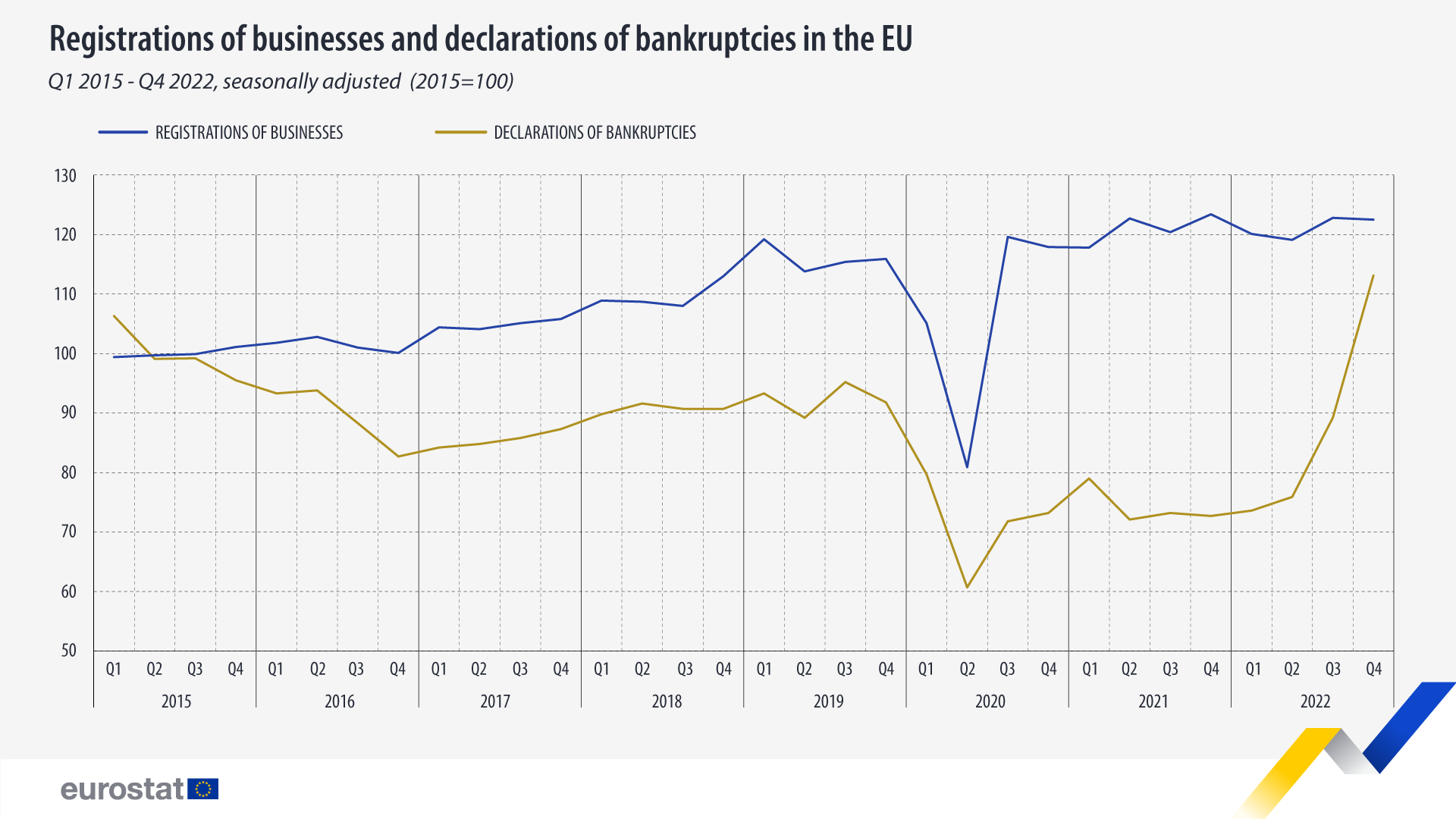
In the EU as a whole the number of bankruptcy declarations initiated by businesses increased substantially (26.8%) quarter-on-quarter in the fourth quarter of 2022, reaching the highest levels on record since Eurostat began collecting EU-wide bankruptcy data in 2015. The number of bankruptcy declarations increased during all four quarters of 2022. As the Eurostat graph below shows, at the current rate of business destruction it won’t be long before businesses are closing at a faster rate than they are opening.

Line graph: Registrations of business an declarations of bankruptcies in the EU, seasonally adjusted, 2015=100, Q1 2015-Q4 2022

This trend, of course, was not hard to foresee. In August 2022, I warned that the EU’s largely self-inflicted energy crisis and resulting inflation is tipping legions of small businesses over the edge:

After reeling from one crisis to another, Europe’s heavily indebted and deeply debilitated small businesses — the backbone of the economy — face the ultimate threat from energy shortages and soaring prices.

With the specter of stagflation looming large over Europe and the price of energy rising at a blistering pace, hundreds of thousands, perhaps even millions, of small businesses face the grim prospect of closure this winter. In the UK, much of the news cycle in recent weeks has been dominated by the plight of struggling families grappling with surging energy bills. But many businesses are, if anything, in an even worse pickle, since they don’t have price caps on the energy they pay. Some business owners are facing an increase in bills of more than 350%.

Across Europe small and medium-sized businesses (SMBs), particularly in sectors like travel and tourism, culture and hospitality, have borne much of the brunt of the economic fallout of the pandemic. The stimulus packages — including furlough programs, debt moratoriums and low-interest emergency loans — helped to tide over many (but not all) of the worst-hit businesses but that support has ended. Meanwhile many of the economic problems spawned by the pandemic, including supply chain bottlenecks and labor shortages, continue to linger. Energy shortages and surging prices are likely to be the final straw.

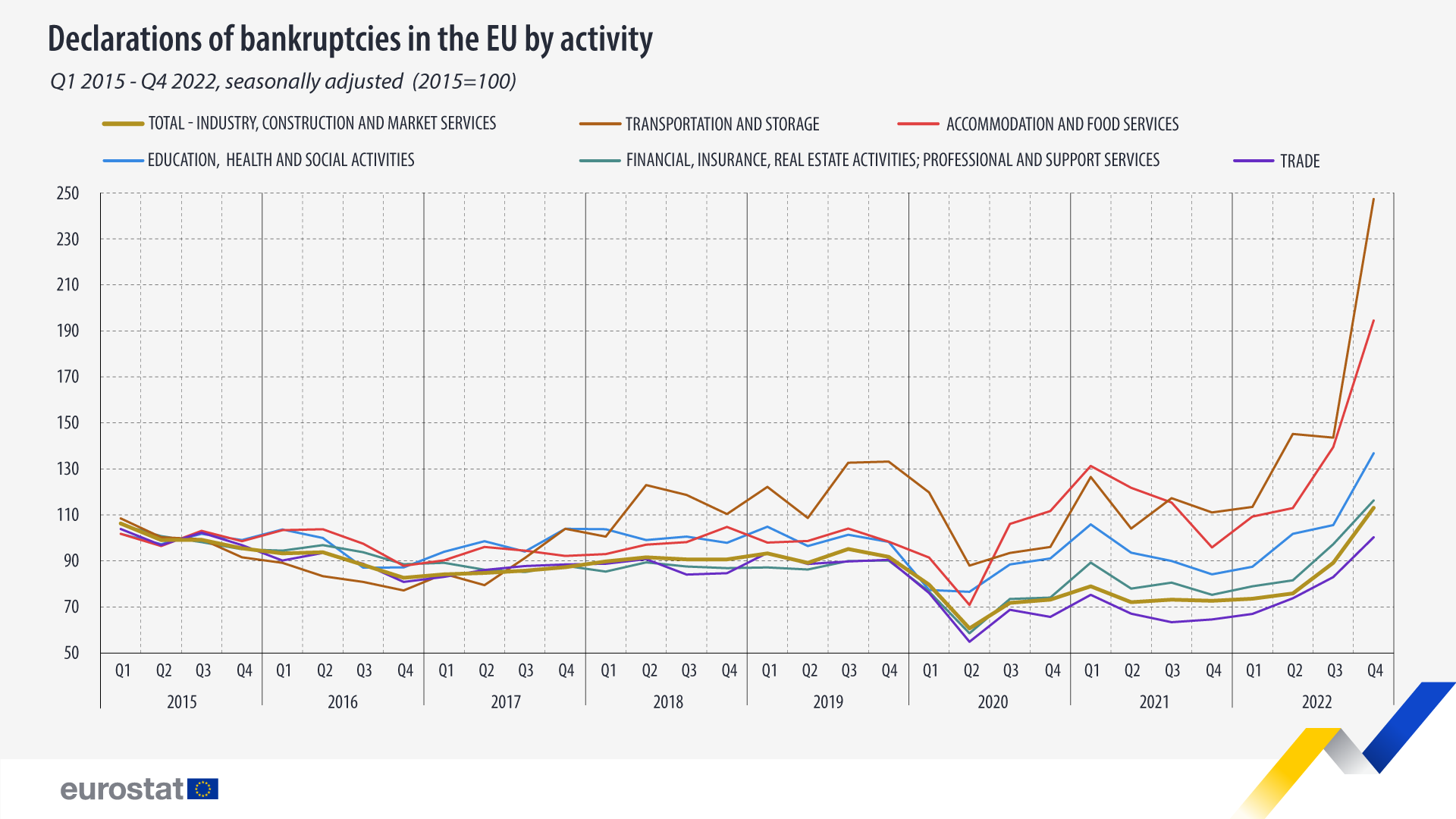
In 2022, inflation in the EU tripled to 9.2%, its highest reading ever. According to Eurostat, all economic sectors witnessed a rise in the number of bankruptcies in the fourth quarter of 2022 compared with the previous one. But the hardest hit sectors were transportation and storage (+72.2%), accommodation and food services (+39.4%), education, health and social activities (+29.5%), sectors that had already suffered significantly during the pandemic.

Line graph: Declarations of bankruptcies in the EU by activity, seasonally adjusted, 2015=100, Q1 2015-Q4 2022

The contrast with the pre-pandemic bankruptcy rate is particularly striking. Compared to the fourth quarter of 2019 — the last quarter before the Covid-19 lockdowns and other pandemic restrictions came into effect — bankruptcies in the accommodation and food services sector surged by 97.7%, while the transportation and storage industry registered a similarly noteworthy 85.7% increase.

As I reported in February, companies in the United Kingdom, now a distinctly non-EU member, are hitting the wall at the fastest rate since the Global Financial Crisis. Much the same is happening across large parts of the European mainland…

Read the full article on Naked Capitalism

Mexico’s President AMLO Sends Strong Message to US Neocons: Mexico is Nobody’s Colony

“We will not allow any foreign government to intervene in our territory, much less with armed forces,” AMLO told US neocons. 

Relations between US and Mexican lawmakers plumbed new lows this week, as a coterie of Republican senators, congressmen and a former attorney general called for direct US military intervention against Mexico’s drug cartels. They included Lindsey Graham, who has lent his support to every single US military intervention and regime change operation since becoming senator in 2003. Together with John McCain, he helped lay some of the ground work for the NATO-Russia proxy war in Ukraine, famously telling Ukrainian soldiers: “your fight is our fight”.

Setting the Stage for US Military Intervention

Now, Graham wants to introduce legislation to “set the stage” for U.S. military force in Mexico, saying it is time to “get tough” on the southern neighbour’s drug cartels and prevent them from bringing fentanyl across the border. The senator’s intervention came just days after four US citizens were kidnapped in the northern Mexican city of Matamoros, two of whom were killed. It is not yet clear why the kidnapping place, but all four of the victims had lengthy rap sheets for drug offences. Whether that has any bearing on the crime has not been confirmed.

Graham added he would “introduce legislation to make certain Mexican drug cartels foreign terrorist organizations under U.S. law and set the stage to use military force if necessary.” Graham escalated tensions on Thursday by describing Mexico as a “narcostate”. His  words elicited a furious response from Mexico’s President Andrés Manuel Lopéz Obrador (AMLO for short), who said (translated by yours truly):

Once and for all, let’s set our position straight. We will not allow any foreign government to intervene in our territory, much less with armed forces. And from today we will begin an information campaign for Mexicans and Hispanics that live and work in the United States to inform them of what we are doing in Mexico and how this initiative of the Republicans, besides being irresponsible, is an insult to the Mexican people and a lack of respect to our independence and sovereignty. And if they do not change their attitude and continue using Mexico for electoral propaganda… we are going to recommend not voting for this party.

This would be no small matter, given that 34.5 million Hispanic Americans were eligible to vote in 2022’s mid-terms, making Latinos the fastest-growing racial and ethnic group in the U.S. electorate. According to Pew Research, the number of Hispanic eligible voters increased by 4.7 million between 2018 and 2022, accounting for 62% of the total growth in U.S. eligible voters during that time. And AMLO has significant influence over this demographic. But that is unlikely to have much of an effect on the Republican neocons pushing for direct US intervention against Mexican drug cartels.

They include, all too predictably, Senators Ted Cruz and Marco Rubio. Also on board are Reps. Dan Crenshaw and Stephen Walts, who in January presented a joint resolution in Congress seeking authorisation for the “use of United States Armed Forces against those responsible for trafficking fentanyl or a fentanyl-related substance into the United States or carrying out other related activities that cause regional destabilization in the Western Hemisphere.”

Mexico’s “Narco-Terrorists”

Also along for the ride is former Attorney General (under both George HW Bush and Donald Trump), whom the late New York Times columnist William Safire used to refer to as “Coverup-General Barr” for his role in burying evidence of then-President George H.W. Bush’s role in “Iraqgate” and “Iron-Contra.” In an op-ed for the Wall Street Journal, Barr likened Mexico’s “narco-terrorists” to Isis and calls Reps. Crenshaw and Waltz’s joint resolution a “necessary step”:

What will it take to defeat the Mexican cartels? First, a far more aggressive American effort inside Mexico than ever before, including a significant U.S. law-enforcement and intelligence presence, as well as select military capabilities. Optimally, the Mexican government will support and participate in this effort, and it is likely to do so once they understand that the U.S. is committed to do whatever is necessary to cripple the cartels, whether or not the Mexican government participates.

Barr called AMLO the cartel’s “chief enabler” for refusing to wage war against the cartels with quite the same zeal as his predecessors:

“In reality, AMLO is unwilling to take action that would seriously challenge the cartels. He shields them by consistently invoking Mexico’s sovereignty to block the U.S. from taking effective action.”

Bizarrely, Barr makes this claim even as the US and Mexico are quietly intensifying their military cooperation. As the investigative journalism website Contralinea reports, one of the millions of documents leaked in a massive cyberattack on the Mexican Secretariat of National Defense (Sedena), in October revealed the extent to which the US and Mexican armed forces are deepening their collaboration on “shared security challenges” such as combating organised crime, arms, drugs and people trafficking.

According to the leaked GANSEG document, the objective going forward of the Armed Forces of Mexico and the United States is to interact (emphasis my own) “closely, efficiently and in an orderly manner to strengthen bilateral military cooperation in matters of protection and regional security, evaluating existing bilateral mechanisms in order to work with a common strategic vision.”

The tactical-strategic bilateral military cooperation framework will also involve trilateral meetings between the defence ministers of Mexico, the United States and Canada. But that apparently isn’t enough for certain Republican neocons, who want the US government and military to take matters into their own hands…

Read the full article on Naked Capitalism

Mexico’s President AMLO Floats Plan to Form Anti-Inflation Alliance in Latin America

“We are going to carry out an anti-inflation plan of mutual aid for growth, for commercial and economic exchange with Latin American countries.”

As US lawmakers, both current and former, escalate their war of words on Mexico’s government while also raising the stakes over Mexico’s proposed partial ban on GMO corn, Mexico’s government is looking to strengthen its ties with like-minded governments to the south. To that end, it has proposed forming a common front with at least five other Latin American countries to combat inflation, especially in food prices, across the region.

“We are going to carry out an anti-inflation plan of mutual aid for growth, for commercial and economic exchange with Latin American countries,” Mexico’s President Andrés Manuel Lopéz Obrador (AMLO for short) said during his daily press conference last Thursday.

For the moment, the fledgling plan is sparse on details. AMLO said the agreement will largely consist of removing tariffs and other trade barriers that prevent food from reaching domestic markets at low enough prices. Producers, distributors, merchants, importers, and exporters will be invited to join the initiative, he said.

“We are starting, we are going to start like this and little by little it will expand,” AMLO said. “We are going to invite producers, distributors, merchants, importers. Who sells, who buys. Get prices, remove tariffs, barriers that prevent you from obtaining food at a good price.”

It all sounds rather neoliberal but the governments AMLO has invited to join the initiative are exclusively left leaning. They include Lula’s newly formed government in Brazil, Gustavo Petro’s in Colombia, Luis Arce’s in Bolivia, Alberto Fernandez’s in Argentina, Xiomara Castro’s in Honduras and, most controversially for Mexico’s neighbour to the north, Miguel Diaz-Canel’s in Cuba. All have apparently agreed to take part in a teleconference on April 5, to be followed shortly thereafter by a face-to-face meeting.

“The foreign ministers, secretaries of Finance, Economy, and Commerce are going to start working to seek exchanges in exports, imports of food and other goods with the goal of confronting the high cost of living together,” AMLO said.

In recent years the AMLO government has tried to drive regional cooperation in Latin America through mechanisms such as the Community of Latin American and Caribbean States (CELAC). In 2021, AMLO proposed using CELAC as a vehicle to create in Latin America something similar to the European Economic Community, the six-member economic association formed in 1957 that would eventually evolve into today’s 27-member European Union.

But he also emphasised “the need to respect national sovereignty and adhere to non-interventionist and pro-development policies” as well as ensure that any resulting structure is “in accordance with our history, our reality, and our identities.” AMLO hopes CELAC will eventually supplant the widely reviled Washington-based Organization of American States (OAS) as the main institution for intra-regional relations.

A Historic Bugbear

With few exceptions, inflation has been a historic bugbear in Latin America. In Brazil and Mexico, the region’s two largest economies, anybody over the age of 40 can remember what life was like under high — or in Brazil’s case hyper — inflation. They don’t want to go through it again. To keep inflation in check and defend their currencies against a rapidly strengthening dollar, the Banco Central do Brasil and Banco de Mexico (Banxico for short) have respectively raised their benchmark rates 12 and 14 times over the past two years.

The results have been mixed. While the consumer price indices in both countries have falled in recent months, they still remain painfully high, at 5.77% in Brazil and 7.91% in Mexico. And the countries’ double-digit interest rates are placing further strains on struggling businesses and families. In the case of Brazil, Lula has even locked horns with the central bank over the high rates. Meanwhile, the Mexican peso has risen to a near 5-year high against the dollar, in part because it is one of the few large economies in the world offering a positive real interest rate. The Brazilian real has also strengthened somewhat in recent months.

In other parts of the region, inflation is an even bigger problem. In early February, Argentina’s central bank unveiled plans to issue a new 2,000 peso note in response to the country’s soaring inflation, clocking in at 98% in January). In Colombia, the annual inflation reached 13.28% in February, its highest reading since March 1999. Inflation is also close to decade highs in Chile (12.3%) and Peru (8.65%). Two outliers at the lower end of the spectrum are Ecuador (2.5%) and Bolivia (2.9%).

In contrast with Mexico, Brazil and many other economies in the region, Bolivia’s benchmark interest rate is currently relatively low, at just below 3.5%. There are two main reasons why Bolivia has been able to outperform on inflation while keeping rates relatively low: first, for more than a decade the government has operated a fixed exchange rate with the dollar; and second, it provides state subsidies for gasoline, food and other basic products. However, as a consequence of these long-running policies, Bolivia’s foreign currency reserves are running low

Read the full article on Naked Capitalism

Tesla’s Newly Announced “Gigafactory” in Northern Mexico Already Has a Serious Problem: Water Scarcity

The nearshoring trend is triggering a significant influx of global companies, including Tesla and many of its suppliers, to Northern Mexico, particularly the state of Nuevo León. But is there enough water to go round?

At his morning press conference on Tuesday, Mexico president Andres Manuel Lopez Obrador (AMLO for short) announced that US electric carmaker Tesla had agreed to build its sixth gigafactory in Santa Catarina, a small city on the outskirts of Monterrey, in the northern state of Nuevo León. The initial investment is said to be worth around $5 billion and is expected to create up to 6,000 new jobs. But there are major concerns about the added strain Tesla’s operations will place on the region’s already stretched water resources.

A Once-in-a-Generation Drought

Nuevo León last year suffered its worst drought in 30 years. By early spring two of the city’s reservoirs had run dry, supermarket shelves were stripped of bottled water amid fits of panic buying and local authorities had begun limiting access to water to six hours a day. The drought affected 38 of the state’s 51 municipalities, including large swathes of Monterrey, Mexico’s second largest city and biggest industrial hub. Demonstrators blocked roads to protest the water shortages. The federal government declared the water crisis a matter of national security and seized temporary control of “private” water well concessions.

This year is not looking much better, according to Juan Ignacio Barragán, the director of the Monterrey Water and Drainage Company:

“The aquifers are low, the rains were not enough to replenish them, we have spent several years with very little rain, the aquifers keep going down and down, just like the reservoirs. In some cases…, all the wells are going down, it is part of the problem we are experiencing”.

Nuevo León’s business-friendly state governor, Samuel García, blames the water shortages on climate change while trying to attract as many foreign companies as possible to his state. But as Jacobin’s Kurt Hackbarth notes, while climate change is certainly playing an important part in Mexico’s growing water crisis, there is much more to this story:

Monterrey is also home to the nation’s soft-drink and beer industry, whose factories — much to the anger of local residents — have not ceased pumping millions of gallons of water throughout the crisis. In fact, fifteen of the largest water hogs (including the steel giant Ternium and two subsidiaries of Coca-Cola) are based in the city and account, alone, for 11.8 billion gallons annually — more than forty times the amount assigned for domestic use.

In the nearby countryside, luxury ranches boast of private dams and artificial lakes filled with water deviated from nearby rivers. And while Governor García engages in quixotic attempts to seed clouds for rain, he also found time to attend the kickoff ceremony of another deep well for Heineken, another top water hog, which bought out Mexico’s emblematic Cuauhtémoc beer company in 2010. All of this goes a long way toward explaining why local activists have adopted the following slogan on the source of the crisis: No es sequía, es saqueo (It’s not drought, it’s plunder).

Nearshoring Pressures

Agriculture is also, of course, a huge water hog, accounting for around 70% of total consumption. But in the coming years, industry’s water consumption in Nuevo León is expected to grow significantly as more and more US, European and other global companies relocate part or all of their China-based operations to northern Mexico as part of the nearshoring trend. Much of this trend is being driven by the tax credits the US government’s Inflation Reduction Act (IRA) offers on electric cars produced with components that are entirely sourced and manufactured in North America.

Now, Tesla will also be tapping into Nuevo Leon’s increasingly tight water supplies while benefiting from the US government’s succulent tax credits. Interestingly, AMLO says he spoke to Elon Musk about the possibility of setting up a lithium battery plant in Mexico. Readers may recall that Mexico is home to significant lithium deposits, which AMLO’s government nationalized last year. But AMLO said Tesla’s thirst for government subsidies was prohibitively expensive:

“If the company invests a peso, the government must provide a 1.5 pesos. So, that’s not possible, not with a subsidy like that; we couldn’t grant it.

3,000 Liters of Water Per Vehicle

To build one car, Tesla uses around 3,000 liters of water, which is actually somewhat below the industry average. In the Tesla Impact 2021 report, Elon Musk’s company claimed that it extracted less water per vehicle produced at its manufacturing facilities than most established automakers.

Be that as it may, it doesn’t change the fact that Nuevo Léon’s water resources are already dangerously overstretched, as reports Wired magazine’s Spanish language edition:

Nuevo León is supplied by three dams and only one is more than half full. These are El Cuchillo, Cerro Prieto and La Boca, which together have more than 528 million cubic meters of capacity…

[A]ccording to the daily report on the storage dams issued by the Rio Bravo Basin Agency of the National Water Commission, as of February 26 the El Cuchillo dam was at 46% of its capacity, Cerro Prieto, 4.1%, and Boca, 58.84%.

Just over a week ago, it seemed that concerns over the local water supply would end up derailing the deal. AMLO’s government was pressuring Musk to locate the Tesla plant in one of Mexico’s south-eastern states where access to water is far less of a problem. AMLO’s government has been trying to spread business activity more evenly across the country by encouraging both domestic and foreign manufacturers to relocate some of their operations from the wealthy northern regions to the poorer states in the south.

But Musk has his heart set on Santa Catarina, in large part due to its proximity to Austin, Texas, TESLA’s global headquarters and US manufacturing base. Also, Tesla’s largest supplier of aluminium is already based in the region, which will make logistics easier.

But the wrangling continued until just one day before Tesla’s all-important Investor’s Day (March 1). AMLO even said Tesla would be denied permits to build a plant in Nuevo Léon if water in the region is scarce, which it clearly is…

Read the full article on Naked Capitalism