Financialization of Housing in Europe Is Intensifying, New Report Warns

Since the Global Financial Crisis residential property in European cities has become an attractive asset class for financial institutions, many in the U.S. The virus crisis has merely intensified this trend. 

Before I get to the meat of this piece, I would like to begin by highlighting two related developments that took place in the past 48 hours. First comes a story from my home region of Catalonia, Spain, where the Catalan Tenants’ Union (Sindicat de Llogateres de Catalunya) has convened a “massive assembly” for this Saturday (Jan 29) to study a new course of action against the U.S. investment fund Blackstone. As an article in the left-leaning publication Publico reports, the objective is to gather and organise the largest possible number of tenants residing in homes owned by the fund, which is widely considered to be the largest landlord in Spain with an estimated 100,000 real estate assets in the country.

Blackstone owns at least 2,300 rental homes in Catalonia, according to the Tenants’ Union. After “difficult” negotiations with the company over affordable rents for tenants and preventing evictions, the union’s representatives say the fund has decided not to renew rental contracts unless the law forces it to. This decision could lead to hundreds or even thousands of “invisible evictions” — i.e., tenants having to abandon apartments they have been living in for years because they are unable to renew their contracts.

From Buyer to Seller

In Spain, Blackstone has turned from buyer to seller over the past year or so as the rules of the market have become less amenable to its interests. The minimum duration of rental contracts for institutional landlords has been extended from three to seven years, which has hampered the ability of institutional landlords to turf out the existing tenants of newly acquired properties as quickly as possible in order to jack up rents for new ones. The Catalan regional government has also passed new housing legislation that includes maximum rents that can be charged for any apartment or home. The Balearic Islands’ regional government has passed a law allowing local authorities to expropriate empty apartments belonging to large investment funds and banks.

Yet even as Blackstone accelerates its withdrawal from Spain’s housing market, it is still increasing its position in other European markets. According to a new study by Daniela Gabor, professor of Economics and Macrofinance at the University of West of England, and Sebastian Kohl, a researcher at the German Max Planck Institute, the U.S. private equity fund has amassed a whopping $700 billion of real estate assets in Europe, including, of course, in the commercial real estate space. And those assets appear to be providing big returns. Blackstone yesterday (Thursday, Jan 27) announced record earnings for 2021, as the Wall Street Journal reported:

Blackstone Inc.’s net income nearly doubled in the fourth quarter thanks to strong investment performance in some of its biggest businesses, as the largest private-equity firm by assets raked in more cash than in any other period in its history,” reported The Wall Street Journal.

The New York firm said earnings rose to $1.4 billion, or $1.92 a share, from $748.9 million, or $1.07 a share, a year earlier. Blackstone’s giant real-estate business helped power the results. Its so-called opportunistic real-estate investments appreciated by 12%, outpacing the 11% gain for the S&P 500.

Despite having on hand an estimated $1.7 trillion of so-called “dry powder” — uninvested but committed capital — when global markets began crashing in April 2020, private equity firms benefited handsomely from the emergency loan programs launched in the CARES act, as I reported in the December 29, 2020 article “Wall Street Mega-Landlord Blackstone Prepares to Reap the Spoils of Another Crisis”:

Many of the firms they owned ended up receiving millions of dollars in low-interest PPP loans from the Small Business Administration (SBA). PE firms such as Blackstone also benefited in a more subtle way from the Federal Reserve’s pledge to buy up to $700 billion of corporate paper, including junk bonds and bond ETFs. In the end the Fed had only bought $13 billion in corporate bonds and bond ETFs as of early December, but its jawboning spurred one of the largest junk bond buying binges in history. And PE firms were among the biggest beneficiaries.

An Increasingly Attractive Asset Class

In the last decade and a half residential property in European cities has become an increasingly attractive asset class for PE firms as well as other financial institutions such as banks, asset managers and insurance companies. Two reasons for this is the region’s near zero (and in the Euro Area negative) interest rates, which mean that institutional investors can fund their property purchases at virtually no cost, as well as an encouraging regulatory backdrop. It’s also worth noting, as Yves did yesterday in her preamble to the Saker’s interview of Michael Hudson, that many mom and pop investors, in Europe as well as the U.S., have also been buying up apartments and homes in population city destinations to rent out on AirBnB.

As Hudson says in the interview, many of the most astute One Percent are taking their money out of financial markets and running into private equity and real estate…

Continue reading the article on Naked Capitalism
Citi’s Hurried Exit From Mexico Just Hit a $5 Billion Snag

An eight-year court case in Mexico involving the New York lender remains unresolved. And it could take another two years to reach a settlement.

US mega-lender Citigroup, as I reported last week, has decided to abandon its retail and business banking operations in Mexico. It will instead focus exclusively on the needs of its investment banking and private banking clients, just as it is doing in many emerging markets in Asia. But the New York lender appears to have hit a snag: at the end of last week, a Mexican judge presiding over an 8-year case involving Citi’s Mexican subsidiary, Citibanamex, and one of its former business clients, Mexican shipping company Oceanografia, blocked the sale of the subsidiary until the lawsuit is resolved. That, he said, could take up to two years.

“The precautionary measures requested by the plaintiff (Oceanografia) are decreed justifiable, as a result of which the defendant Banco Nacional de México, S.A. will be required to refrain from selling or transferring shares, assets and other tangible and intangible assets, until the main trial is resolved in a final judgement,” ruled Judge Mario Salgado Hernández in his resolution.

The judge, head of Mexico City’s 71st Civil Court,  said that if Citi sells Banamex, payment of the amount demanded in the lawsuit must first be guaranteed before the Court. That amount is  $5.2 billion (or its equivalent in national currency), which is a lot of money even for a bank of Citi’s size. To put the money in perspective, Citi reported 7.4 billion pesos (around $400 million) of net income from its Mexican operations in 2020, down from 20 billion pesos in 2019.

“They have announced their intentions to sell Banamex as of March of this year, so we have a justifiable fear that they will leave the country without complying with the obligations of the resolutions issued by the court,” said Jorge Betancourt, Oceanografia’s legal representative. “So, to prevent that from happening, we asked the court to block the sale of the bank until the trial is over or if they leave the amount we are requesting, $5.2 billion, in the form of a guarantee.”

After the judge announced the precautionary measure, Citibanamex said in a statement that “there are no legitimate legal foundations for the judge” to have taken such an action, “particularly given the baseless allegations contained in the lawsuit.” The bank plans to appeal the ruling, adding that it does not expect the matter “to have any impact on its timetable for selling our consumer business in Mexico.”

Accusations of Corruption, Influence Peddling and Money Laundering

The case against Oceanografia, launched in 2014, is one of the biggest corruption and influence peddling cases in recent Mexican history. It still hasn’t been resolved. The scandal came to light when senior management at both Citibanamex and the Mexican state-owned oil company Petróleos Mexicanos (Pemex) accused the shipping company of using a $585 million credit line provided by Citibanamex to obtain hundreds of millions of dollars in cash advances secured by fraudulent invoices purportedly for work performed for Pemex.

In February 2014, Pemex informed Citigroup that $400 million worth of Oceanografia invoices presented as approved by Pemex were forged. As a result, the bank cancelled the credit line, precipitating Oceanografia’s bankruptcy. The New York bank’s then CEO Michael Corbat called Oceanografia’s bogus billing a “despicable crime” — far in excess, of course, of any of the crimes Citi has committed over the years — and cut its fourth-quarter and full year results by about $235 million.

Oceanografia was closely connected to the PAN governments of Vicente Fox Quesada and Felipe Calderon Hinjosa (2000-2012) during whose tenure the petro-plunder of Pemex reached a whole new level. According to a report published in 2014 by the left-leaning investigative journalism magazine Contralinea, the company also had close ties to the brothers Francisco Javier and Óscar Rodríguez Borgio, owners of the company Grupo Gasolinera Mexicano, who were under investigation for oil theft and laundering money for organised crime.

Mexico’s Ministry of Public Function investigated the contracts Oceanografia signed with Pemex between 2011 and 2012, levied a fine of 24 million pesos and disqualified the company from working with federal public administration agencies for 21 months. Amado Yañez, who was CEO and majority owner of Oceanografia when the scandal broke in 2014, was arrested and jailed, only to be released in 2017 on the posting of a 7.5 million peso bail. Yañez still faces charges of fraud and wears an ankle bracelet to this day.

Continue reading the article on Naked Capitalism

Opposition Rises to NHS Vaccine Mandate, As Justifications for Mandate Run Out of Logic

With Omicron evading the current crop of vaccines with effortless ease and the UK Government withdrawing most other virus-control measures, there is no rational justification for vaccine mandates for healthcare staff. 

This Wednesday (Jan 19), the UK Government took the world by surprise — or at least the world outside the UK — by announcing plans to lift almost all of its so-called “Plan B” measures for England. They include mask mandates, social distancing measures and the vaccine passport, which had only been introduced in mid-December. The policy U-turn appears to be an act of political expediency by a government brought to its knees by an endless succession of corruption scandals.

The withdrawal of some of the restrictions could end up seriously backfiring, especially if the UK suddenly sees a fresh resurgence of case numbers in the coming weeks, as has already happened in Denmark. The UK’s embattled Prime Minister Boris Johnson may not last long enough in his job to ensure the policy reversal stays in place. Nonetheless, the move still represented the first outright rejection by the government of a major Western “liberal democracy” of the need for mandatory vaccine passports. That alone is cause for celebration.

As I argue in my upcoming book, Scanned: Why Vaccine Passports and Digital IDs Will Mean the End of Privacy and Personal Freedom, the passports “offer precious little in the way of potential good—and a huge amount in the way of potential harm.” They represent an all-out assault on civil liberties while exposing large segments of the population to unprecedented levels of discrimination and segregation. Yet they do precious little to help countries combat transmission of the virus, which is supposedly their raison d’etre. In fact, they may actually be exacerbating it by giving the recently vaccinated a false sense of security. How else to explain the fact that by the end of 2021 the EU, the region of the world with most vaccine passports per person, was once again ground zero for the COVID-19 pandemic?

Lack of “Rationality” and “Proportionality” 

But one measure the UK Government hasn’t repealed is the vaccine mandate for all NHS staff. From April 1, two jabs will become obligatory for frontline NHS staff after MPs voted on the legislation last month. But opposition is rising to the mandate after a leaked document from the Department of Health and Social Care (DHSC) warned ministers that the new evidence on Omicron – showing vaccine effectiveness dropping to zero – raises serious doubts about the new law’s “rationality” and “proportionality:” More from the Guardian:

The document, drawn up by Department of Health and Social Care (DHSC) officials and seen by the Guardian, said the evidence base on which MPs voted “has changed”, creating a higher chance of objections and judicial review.

The effectiveness of only two vaccine doses against Omicron, and the lower likelihood of hospitalisations from the milder variant, are cited.

More than 70,000 NHS staff – 4.9% – could remain unvaccinated by 1 April, the document says. NHS trusts in England are preparing to start sending dismissal letters from 3 February to any member of staff who has not had their first dose by then.

Amid significant pressures on the NHS, last week groups including the Royal College of Nursing urged Sajid Javid, the health secretary, to delay the legislation, known as “vaccination as a condition of deployment” (VCOD2). An earlier VCOD1 rule applied to care workers and came into force on 11 November.

On Tuesday the Royal College of Nursing said the leaked memo should prompt ministers to call a halt to the imposition of compulsory jabs, which it called “reckless”.

“The government should now instigate a major rethink”, said Patricia Marquis, the RCN’s England director. “Mandation is not the answer and sacking valued nursing staff during a workforce crisis is reckless.”

The document prepared by DHSC officials noted that two vaccine doses provide up to 32% effectiveness against Omicron infection, which wanes to an effective zero 20 weeks later.

Elderly Care in Tatters

The Department of Health and Social Care has already pushed through a blanket vaccine mandate for care home care workers, propelling as many as 70,000 workers out of the sector. Care leaders begged the health secretary, Sajid Javid, a former investment banker, for an 11th hour reprieve, but he refused to listen. That was in mid-November. A month and a half later, the Government announced it was relaxing immigration rules in order to recruit care staff from overseas.

In early January, more than 90 care home operators declared “red alert” on staff shortages, meaning that staffing ratios had been breached. To combat rising staff shortages, Health Secretary Sajid Javid proposed establishing a “volunteer army” of retired nurses, doctors, and carers to take shifts and reduce the burden.

Vic Rayner, chief executive of the National Care Forum, warned: “The spread of Omicron across the country will bring more care homes into outbreak, put huge pressure on the already compromised staff group and mean those who need care do not get it.”

The vaccine mandate not only exacerbated the acute staffing shortages in the UK’s elderly care sector, with some 170,000 estimated vacancies; it also heaped yet more pressure on the NHS’s buckling systems, as more and more care homes were left with little choice but to refuse to take patients from hospitals.

Continue reading the article on Naked Capitalism

As Citi Prepares to Leave Mexico, the Hunt Is On for Its Assets

Big global lenders, including Spain’s Santander and Canada’s Scotiabank, are interested, but Mexico’s President Lopéz Obrador would prefer the country’s third largest bank to pass back into the hands of Mexican owners. 

Last Wednesday (Jan 12), Citigroup broke the news that it was putting up for sale its Mexican retail banking business after almost a century of operating in the country. The U.S. lender said it will retreat from consumer and small and medium-sized business banking in Mexico, which it mostly does via its Banamex subsidiary, which it acquired in 2001. Banamex itself is 137 years old.

The move is part of Citi’s CEO Jane Fraser’s “strategic refresh” of the lender. The bank had already announced plans to withdraw from most of its consumer businesses in Asia, Europe the Middle East and Africa as it focuses its model on wholesale and corporate banking and investment. Citi said it could exit its Mexican operations by selling them or spinning them off into a new listed company. It will keep its investment bank and private bank in Mexico, along with its unit that serves institutional clients in the country.

Big Implications

Citi’s sale of Banamex, Mexico’s third largest lender by assets, will have big implications for Mexico’s financial system. The bank has assets worth around $70 billion, including its consumer and business banking operations, fund management arm, insurance division, branches, and up to $2 billion worth of Mexican art. The private collection is one of the most valuable in Mexico and includes works by Frida Kahlo, Remedios Varo and Leonora Carrington as well as the muralists José Clemente Orozco and Diego Rivera.

Citi is not the first big global lender to leave Mexico in recent times. In 2021, JPMorgan announced the closure of its private banking operations in Mexico,  as wealthy clients in some of Latin America’s largest economies did what they always do during crises: they shifted their money to international financial capitals. In 2020, the bank did exactly the same with its operations in Brazil.

Fears are now rising that Mexico may be going through the beginnings of yet another bout of capital flight. According to data published by the Bank of Mexico, foreign investors cashed out €12.63 billion dollars from Mexican bonds on 2021. It is the highest amount since figures began being collected in 1992, even surpassing the total for 2020.

The move coincides with a slowdown in Mexico’s post-2020 economic recovery as well as an anticipated shift in the Federal Reserve’s monetary policy, As I warned in my December 10 article,  “Inflation Continues to Soar in Latin America, Even As Central Banks Intensify Their Rate Hikes,” this is one of the biggest fears in Latin America: “if financial conditions in the U.S. and other advanced economies were to suddenly tighten, as the Fed and other major central banks begin hiking rates to stifle inflation (which isn’t beyond the realms of possibility), it could spark sharp asset sell offs and capital outflows in their own economies.”

Analyst Gabriela Siller, from Mexican investment bank Banco Base, put the capital outflow down to “risk aversion regarding the Mexican economy:”

“This is due to low growth but also government initiatives. This year we have the debate on electricity reform, so it is very likely that risk aversion and capital light will continue.”

On the same day that Citi announced it was leaving Mexico, Mexico’s Ministry of Finance issued a statement trying to dampen fears: “Citigroup’s decision does not reflect a lack of confidence in Mexico,” it said. Citigroup “notified the country’s tax authorities in a timely manner of its decision to exit the retail and corporate banking business, which forms part of its global strategy.”

The Hunt Is On

The question now is: who gets to buy the bank’s assets, and for how much?

Continue reading the article on Naked Capitalism

Remittances Soar to Record High in Latin America, Providing a Lifeline for Desperate Economies

Remittances are a vital source of income and foreign currency for many countries but are no substitute for home-grown development.

Between January and November of 2021 Mexico received $46.83 billion in remittances — transfers of money by workers of Mexican descent largely in the US but also other countries to individuals in Mexico. It is a 27% increase on the same period of 2020, which itself was a record year for remittances. According to El Financiero, it’s the highest rate of increase in 18 years.

The Bank of Mexico still hasn’t published the data for December 2021 but barring a sudden, sharp reversal, Mexico’s remittance haul for 2021 will surpass $50 billion for the first time ever. That’s after increasing by 11.4% to $40.6 billion in 2020, a year when the U.S. economy, where 98% of the remittances to Mexico originate, suffered its worst annual contraction since 1946.

Mexico has registered 19 straight months of rising remittance inflows. Between January and November 2021, almost 124 million remittance payments were registered, 14.2% more than in the same period of 2020. Mexican migrant workers are not just sending money back home more often; they are sending larger amounts each time. The average remittance in the period was $378, 11% higher than in 2020.

“A Blessing” for Mexico

On Friday, Mexico’s President Andres Manuel Lopez Obrador (AMLO) described the trend as a “blessing” for the country he leads:

“It is the main source of income for Mexico. The data for December is an estimate, but I can tell you we have figures before the Bank of Mexico [releases its data] and we make a projection and it generally matches up, and we are calculating that by December… we will be at $51.63 billion… the equivalent of eight thousand pesos a month for 10 million families.”

Mexico is not the only Latin American country to have seen a sharp rise in remittance flows in 2021. According to the World Bank’s latest projections, published in November, Latin America and the Caribbean would receive a record remittance haul of $126 billion dollars in 2021, which would represent an increase of 21.6% on 2020. Mexico would account for just over 40% of the total.

In most parts of the world, remittances increased in 2021. Though the full data for the year is not yet available, the World Bank estimates that remittances to low- and middle-income countries grew by 7.3% in 2021, to reach a record $589 billion:

For a second consecutive year, remittance flows to low- and middle-income countries (excluding China) are expected to surpass the sum of foreign direct investment (FDI) and overseas development assistance (ODA). This underscores the importance of remittances in providing a critical lifeline by supporting household spending on essential items such as food, health, and education during periods of economic hardship in migrants’ countries of origin.

The bank expected remittances to grow by 9.7% in the Middle East and North Africa, 8% in South Asia, 6.2% in Sub-Saharan Africa and 5.3% in Europe and Central Asia. The only region where remittances were forecast to fall in 2021 was the Asia Pacific.

The rapid recovery and dramatic resurgence of remittances is one of the big — and largely pleasant — economic surprises of the pandemic era. In April 2020, at the onset of the pandemic, the World Bank painted the bleakest of pictures for global remittances. As the global economy seized up, financial markets plunged and many migrant workers lost their jobs or hurried home, the multilateral lending institution warned that remittances would drop precipitously, just as had happened in the wake of the Global Financial Crisis:

Remittance flows are expected to fall across all World Bank Group regions, most notably in Europe and Central Asia (27.5 percent), followed by Sub-Saharan Africa (23.1 percent), South Asia (22.1 percent), the Middle East and North Africa (19.6 percent), Latin America and the Caribbean (19.3 percent), and East Asia and the Pacific (13 percent).

Fortunately, the forecasts were wildly off target. In the end, global remittances declined by only 1.7% in 2020 and in some regions, such as Latin America, they actually ended the year in positive territory. That trend accelerated sharply in 2021.

Continue reading on Naked Capitalism

Mexico City Grapples With Acute Water Shortages, As “Day Zero” Approaches

Unless dramatic steps are taken, one of the world’s largest cities could face “Day Zero” — when supplies of water run so low that government must begin rationing the precious liquid — as early as 2028. 

Many residents of the working class barrio of Azcapotzalco, in the northwestern part of Mexico City, had a very dry Christmas this year. Water stopped flowing to many households on Christmas Day, allegedly the result of an outage of three power stations in an electrical substation that provides power to wells in the neighbourhood. Representatives of Mexico City’s Sacmex Water System said the situation would be resolved in a matter of hours. In the end, it took ten days, and only after local residents had forced the issue, in classic Mexican fashion, by blocking key roads in the neighbourhood.

“They told us they were going to bring us water tankers and that the service would be fully restored the day after,” Paty Pérez, a resident of the area, told the daily newspaper Excelsior. “It is impossible for us to live without water. Azcapotzalco is one of the municipalities that always lacks water; there are elderly people who live on the fourth floor of their buildings who have to carry the water up the stairs.”

It is not just poor neighborhoods that are feeling the effects of Mexico City’s worsening water crisis. Whenever my Mexican wife and I come to her native city (where we are at the moment), we stay in a 13th floor apartment on the edge of the leafy, colorful middle-class barrio of Coyoacan, which is home not only to the Museo de Frida Kahlo but also the former home of Leon Trotsky, both well worth a visit. The apartment belongs to a generous, gregarious septuagenarian Argentinean emigree whom my wife regards as an adopted aunt.

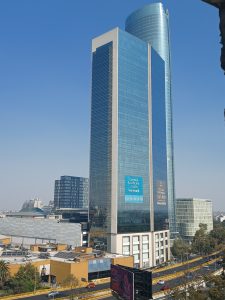
She and her neighbours are also having problems with water. At any moment, particularly in Spring, the supply can suddenly run dry and may not return for a number of hours or even until the next day. This has been happening for many years but it began occurring a lot more frequently when work began, in 2012, on a giant skyscraper complex a few blocks away called Complejo Mitikah. The complex features two office towers, one owned by We Work, both of which are overshadowed by Mitikah tower, a 67-floor apartment building that, once finished, will be Mexico City’s largest residential skyscraper.

The complex is billed as a fully self-contained “vertical city” that will include a giant shopping mall, a supermarket, a private hospital, gyms, swimming pools, boutique restaurants and bars. If the skyscraper’s residents, many of whom will no doubt work from home, would rather not venture out into the city, they won’t have to; just about everything they could possibly want or need is on site.

Naturally, the complex has massively increased the demand for water in the local neighborhood, but it is other local residents that are paying the price. More and more often, the underground water tanks that serve nearby residential buildings are running dry. This is particularly true in Springtime, just before Mexico’s rainy season begins. It can take hours or in extreme cases even days before water tankers arrive to refill the tanks. On public holidays or over long weekends the government can sometimes cut off water to residents in order to carry out much-needed maintenance work.

Two Dry Years

Mexico has suffered two consecutive years of low rainfall. The situation was already severe in April 2021. As an article in El País noted in May, “surviving the dry season depends in large part on how much water has been accumulated during the wet months”:

“In 2020, the rains were not sufficient to fill all of the country’s network of dams and now, as a consequence, of the 210 biggest in Mexico, more than half are at less than 50% of their capacity. Furthermore, 61 are at critical levels at less than 25% capacity, mostly in northern and central Mexico.”

Mexico is no stranger to water crises. In 1996 and 2011 the country suffered severe droughts but as the El País article points out, lessons were not learnt. 

Continue reading on Naked Capitalism