Vast Euro-Derivatives Market, Centered in London, Is Set to Fragment as End of Brexit Transition & Uncertainties Loom

It shouldn’t “create risks to the stability of the financial system,” which is soothing to know.

About 43% of the $9.4 trillion in daily global derivatives trades tracked by the Bank for International Settlements are executed in the U.K. A large chunk of them are euro-denominated, but some of those trades will soon have to be executed elsewhere, according to the Paris-based European Securities and Markets Authority (ESMA), which announced on Wednesday that once the Brexit transition period expires, on Dec. 31, trading in euro-denominated derivatives must remain within the EU’s jurisdiction or in a country with “equivalent” standards to the bloc.

From that day, EU investors will have to use a swaps platform inside the bloc, or based in a non-EU country that — unlike the UK — has been granted “equivalence,” such as the US. As a result, branches of EU banks in London will have to grapple with conflicting EU and British trading obligations. British counterparties will have to use a UK authorized platform, while EU counterparties will have to use an EU authorized platform, making a trade between the two sides impossible.

“The decision is a starting gun for a fight between the UK and the EU for the location of international derivatives trading in Europe,” said Michael McKee, a financial services lawyer at DLA Piper law firm.

Toward a Fragmented Market

The result will be a much more fragmented European derivatives market. That is likely to be bad news for the UK’s all-important financial services industry, which accounts for more than one-tenth of the UK’s tax revenues and one-fifth of its service exports. It may also impact investors and companies, whose financing costs may rise as a result.

ESMA acknowledged that the situation “creates challenges for some EU counterparties, particularly UK branches of EU investment firms.” On the bright side, it shouldn’t “create risks to the stability of the financial system,” which is a relief.

At this late stage in negotiations, the only way this rupture of Europe’s derivatives markets can be halted is through a last-minute deal that grants so-called “regulatory equivalence” to the UK’s financial services industry. Or failing that, a last-minute extension to the transition phase.

Continue reading the article on Wolf Street
Australian Construction & Real-Estate Development Giant Grocon Hits Wall, amid Industry Swoon that Started in Mid-2019

The Pandemic accelerated the mess.

Construction and real-estate development giant and funds management firm Grocon Group — which built some of Australia’s most iconic modern buildings, including three of its five tallest skyscrapers, as well as major projects in India and Abu Dhabi — declared insolvency on Friday, according to ABC News, and is putting several of its construction companies into administration (a form of bankruptcy), following years of legal wrangles, industrial disputes, and months of lockdown. The company, which is family owned, reportedly owes tens of millions of dollars to creditors, including hundreds of subcontractors.

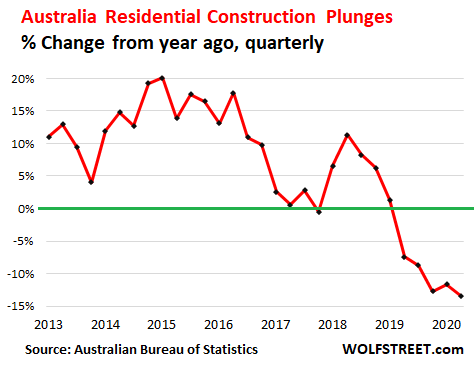
Australia’s construction industry, which accounts for 13% of Australia’s GDP and one in ten jobs, has been in cyclical decline since mid-2019. The residential building segment has borne the brunt of this downturn — largely a result of banks being forced to rein in their reckless lending in the wake of the Royal Commission’s investigation into their dodgy mortgage lending practices. The disruptions from last year’s bushfires then added to it. By Q2 2020, according to the latest data from the Australian Bureau of Statistics, construction activity tumbled 12.5% from Q2 2019 and 20% from Q2 2018:

Grocon also runs a real estate investment and asset management platform in a joint venture with UBS. And it built smaller developments in Australia and recently won a AUD75 million contract to help clean up and rebuild after Victoria’s recent bushfires.

Like many construction companies, Grocon has been pummeled by the coronavirus outbreak and the strict lockdowns that ensued, bringing some projects to a standstill.

For many of the small businesses and subcontractors that do much of the hands-on work on big construction sites, the strains are already becoming unbearable. Late payment of invoices has long been a scourge in Australia, particularly in the construction industry, creating huge cash-flow problems for companies lower and lower down the value chain. While the government has pledged to take action, the problem, according to some reports, appears to be getting worse as more and companies fall behind with their bills.

The work-from-home and strict social distancing measures have put immense strain on office and apartment developers, many of whom have struggled to balance high-cost building commitments with slow sales and non-paying tenants.

But Grocon was already in deep trouble before the crisis had even begun. A major source of its woes was a joint venture with the Chinese developer Aqualand and shopping center group Scentre to build a shopping center, apartments and open space at Central Barangaroo, on Sydney’s waterfront. One of the development’s biggest selling points was the privileged views it would have overlooking the Sydney Opera House and Harbour.

The problem was that the New South Wales government had also promised the exact same views to another project on Barangaroo: the Crown’s hotel and casino development. If Grocon finished its project first, the apartment buildings would have blotted out those views. To prevent that from happening, the project’s developers, Crown Resorts and Landlease, sued the government of New South Wales to protect the “sight lines” from their developments. And they won.

Continue reading the article on Wolf Street
Can the “Valuations” of Office Properties in London Be Trusted, Asks Royal Institute of Chartered Surveyors

These “valuations” are crucial to metrics of REITs and property mutual funds, including net asset value (NAV), amid concerns about conflicts of interest.

In its third quarter report on the state of the UK’s commercial property market, the Royal Institute of Chartered Surveyors (RICS) said that expectations for a decline in rents for prime office space were “the most widespread” since records began in 2014. Yet valuers have barely marked down their valuations of office properties in London, prompting some to question whether they are conflicted by the lucrative contracts they have with the UK’s largest REITs and property mutual funds.

With the UK once again back in lockdown, all workers who can work from home — including the lion’s share of London’s office workers — have been urged to do so. Many of them never returned to the office to begin with. Research published by Morgan Stanley in October found that only 49% of UK workers had made it back to their workplace as of October. This is a particular issue in London, and London-based employers, lumbered with largely empty office space, have begun in recent months to dump at least part of that real estate as subleases on to an already saturated market.

Between June and September alone, more than 1 million square feet (92,900 square meters) become available as firms, including some of the City’s biggest banks, sought to sublet space they no longer needed. Since the start of the virus crisis, the availability of office real estate has mushroomed to almost 20 million square feet, from a 10-year average of 14 million square feet. It is growing at the fastest rate, in net terms, since 2009, according to RICS.

Yet despite plunging demand and rising vacancies, valuers have barely marked down the properties belonging to their clients. This has prompted some in the industry to question the validity of the valuations, reports The Times of London.

“The valuers are now in denial on offices just as they have been for years on retail,” said former Treasury minister Lord Oakeshott, who runs London-based commercial property firm Olim Property, which has no exposure to office or retail properties. “London office rents are clearly in freefall, with very little occupier demand, but the valuers are only marking them down by 0.2% or 0.3% a month.”

The Institute of Chartered Accountants in England and Wales was the first to raise the alarm about property valuations, warning that it sometimes finds “little evidence to support” their validity. RICS, the UK property industry regulator, has launched a review of how property valuations are conducted in response to rising concerns about potential conflicts of interest in the industry. Depending on its findings, it may consider imposing mandatory rotation of valuers

Relationships between REITs and valuers and property mutual funds and valuers tend to last for decades, giving rise to very cozy, deep-seated ties. In some cases, a surveyor may even act as valuer for a firm while also having a seat on the firm’s board. These cozy relationships may make it more difficult for a surveyor to reduce its estimated value of properties belonging to an important client, since it could have a material impact on that client’s performance.

For REITs, the reported valuation has a major bearing on the company’s performance metrics, which in turn affect the share price. In the case of open-ended property mutual funds, the price at which investors subscribe and redeem their shares is determined by net asset value (NAV), so the valuation directly impacts their returns too.

The concentration and governance of the valuation industry are also under scrutiny, having drawn comparisons with the UK’s scandal-tarnished audit profession, which has been dominated for decades by the “Big Four” global accountancy firms (KPMG, EY, PwC and Deloitte) but is now finally undergoing an overhaul.

Continue reading the article on Wolf Street
How the Unemployment Fiasco in Europe Is Kept out of Official Unemployment Rates

The massive and once-again extended Pandemic-era furlough programs serve their purpose, but…

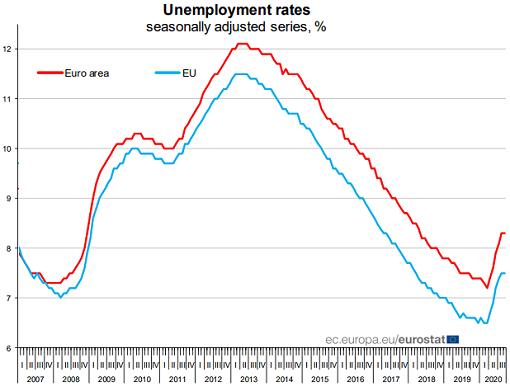
In Europe, people who are furloughed are paid under government programs via their employers. Many of these programs have been created during the Pandemic. In theory, these people still have jobs. In practice, they’re not working, or are working heavily reduced hours. But they do not count as “unemployed” and are not reflected in the “unemployment” numbers. So throughout the Pandemic, the official unemployment rates barely ticked up, compared to the last crisis, and remain low for the EU era, despite tens of millions of people who’d stopped working due to the lockdowns (chart via Eurostat):

Under these furlough programs, the government pays companies, who in turn pay employees between 60% and 84% of their monthly wage. In some cases, the workers work fewer hours for less pay; in others, they don’t work at all. The workers take a hit to their income but their jobs remain intact, at least for the duration of the program.

The UK adopted a sweeping furlough program at the beginning of its last lockdown. Businesses can claim 80% of a staff member’s regular monthly salary, up to a maximum of £2,500. The money must be passed on to the employee and can also be topped up by the employer.

But the unemployment rate has begun to rise as people come off furlough, and those whose jobs disappeared entered official unemployment. The unemployment rate ticked up to 4.8% in the three months to September, from 4.5% in Q2 and from 3.9% a year earlier, according to the Office for National Statistics (ONS). In London, the unemployment rate surged by 1.2 percentage points from the previous quarter, to 6%, the largest quarterly increase in unemployment since the ONS started tracking the data in 1992.

Extend and pretend. Most of Europe’s job programs were initially described as a short-term fix, providing employers affected by the lockdowns time and financial breathing space to reinvent themselves for the new economic reality that is quickly taking shape. But more and more governments extended the duration of their programs, some until 2022, in the hope that the economic outlook will change in the interim.

One country that said it wouldn’t do this was the UK. But it, too, backtracked. The furlough program was supposed to come to an end on October 31. But four days later, just after announcing a fresh lockdown, the government extended the program until March 31, 2021. It also announced a fresh round of measures to support the self-employed. On the same day, the Bank of England pledged an additional £150 billion of QE purchases, which will help ensure there is enough demand for all the new debt the government will need to issue to finance its new commitments.

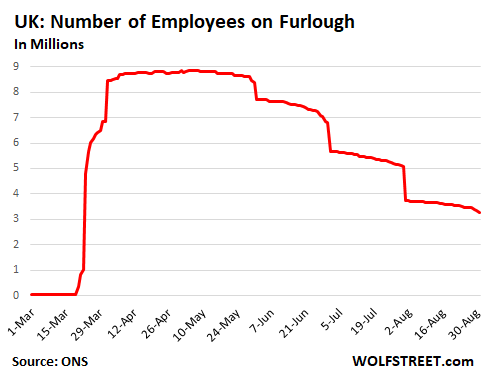
In March, the number of furloughed employees exploded from zero to 8.5 million and remained near 9 million through May, after which it began to drop as the economy opened up. By the end of August, the latest available data, they’d fallen to 3.3 million:

This decline in the number of furloughed workers — some of whom then become “unemployed” — led to the irony that in the UK, as elsewhere, the official unemployment rate rose precisely when the job market was improving. Millions of people whose jobs had been put on hold during the lockdown were able to go back to those jobs once the lockdown was lifted. But many others ended up having no jobs to go back to, either because their employer had gone out of business in the interim or had decided to let them go.

Some companies announced mass layoffs in anticipation of the end of the furlough program. The problem is not just that jobs are disappearing in large numbers; it’s that very few new ones are being created.

Continue reading the article on Wolf Street

Spooked by Fishy Smells & Regulators, Investment Bank Natixis Dumps its 50% Stake in Formerly-$36-Billion Hedge Fund H2O

Blackstone Group, BNP Cardif, Crédit Agricole, and others have also unwound or suspended their relationship with H2O.

Embattled London-based hedge fund H2O Asset Management — with €20 billion ($24 billion) of assets under management, down from €30 billion ($36 billion) last year — has a big new problem on its hands: its majority investor, French investment bank Natixis, has decided to sell its 50.01% stake. The decision comes after an FT investigation last year revealed that the hedge fund had invested substantial funds in highly illiquid assets, and it raises serious questions about H2O’s future.

H20 “will no longer be considered a strategic asset,” said Natixis in its third-quarter earnings statement. “Natixis IM and H2O AM have entered into discussions with a view to unwinding their partnership in a gradual and orderly fashion.”

One way of achieving this, the bank said, would be through an incremental sale of its stake in H20. The alternative would be for H20 to gradually take control of the distribution of its own funds during a transition period lasting until the end of next year. Either way, the result is the same: Natixis is calling it quits on a partnership that goes back 10 years, to H2O’s inception.

Natixis has not given concrete reasons for its decision to cut ties with H2O, apart from as part of a broader de-risking exercise. But it comes after H2O’s recent brush with market regulators in France and Belgium.

At the end of August, H2O was forced by France’s market regulator to gate a number of its funds, due to “valuation uncertainties” resulting from their exposure to high-yielding unlisted securities. Those securities are linked to the scandal-tarnished German financier Lars Windhorst, whose business dealings over the past two decades have left a long trail of bankrupt companies, stiffed investors, and unpaid debts.

Continue reading the article on Wolf Street

Interjet Runs Out of Runway. Six Other Latin-American Carriers Already Liquidated or in Bankruptcy

They didn’t get bailed out by taxpayers. But in a radical experiment these days, investors got to eat the losses, as they should.

Budget airline Interjet, Mexico’s third largest carrier by passenger numbers, canceled its entire roster of flights on Nov. 1 and Nov. 2, leaving some 3,000 passengers stranded, due to its inability to pay for jet fuel.

Flights resumed on Tuesday, by which time the company had apparently scraped together enough money to resume servicing its fuel tab. But many of Interjet’s workers refused to work, choosing instead to picket the company’s Mexico City headquarters over the fact they haven’t been paid their salaries for two months.

And according to one worker who spoke to El Financiero, some benefits, including uniform allowances, housing credits and health insurance payments, haven’t been paid since March.

The strike was halted after the airline agreed to pay one quincena, or fortnightly payment, to workers by the middle of this week. It also said it hoped to pay three quincenas by the end of the week. There’s only one problem: it has no money.

This is despite the fact that a consortium of investors very quietly acquired 90% of the airline for $150 million in July in an operation whose details remain largely secret. According to the newspaper Milenio, the money has not yet materialized, apparently due to concerns that the moment it does, the government will take a large chunk of it to cover tens of millions of dollars of unpaid taxes.

Interjet was founded 15 years ago by the family of former Mexican senator Miguel Alemán Velasco, himself the son of a former president. It has been plagued by financial problems for years. This is partly due to an ill-fated decision, back in 2012, to purchase 22 Sukhoi SSJ100, which were considerably cheaper than other 75-100 seater regional jets on the market but proved to be a nightmare to maintain and source spare parts for. Once they had mechanical problems that could not be easily fixed, planes were simply left in their hangars and ended up being cannibalized for spare parts. By 2019, only five of the 22 aircraft were still operational.

When the virus crisis hit, bringing the global aviation industry to a virtual standstill, Interjet’s problems quickly multiplied. In the past eight months…

  • Mexico’s federal tax agency SAT has imposed an embargo on property belonging to Alemán Velasco due to the airline’s unpaid tax bills.
  • 25 of its leased aircraft were repossessed.
  • Customers have launched a class action suit over its endless cancellation of flights and shady reimbursement practices.
  • The city of Chicago has sued it for failing to pay taxes and fees owed to O’Hare International Airport.
  • The Canadian Transportation Agency withdrew its license to operate in Canada for not having liability insurance coverage.

On Monday, the Mexican government’s consumer protection agency, Profeco, piled on the pressure by warning consumers not to buy tickets from the airline, after receiving 1,500 complaints from customers over cancellations.

“Interjet has been facing a number of problems in its commercial operations for several months, including the suspension of various international routes, the non-payment of salaries, the suspension of its license to operate international air routes to Canada and the embargo of bank accounts, goods and brands,” a notice from Profeco read.

The airline was already on its knees a year and a half ago. In its earnings call for the first half of 2019 — the last time it publicly disclosed its financial accounts — it reported losses of 516 million pesos. Cancellations and delays of Interjet flights became a constant feature of the summer, affecting 21,000 passengers. In August 2019, the airline refused to pay $30 million in unpaid corporate taxes, citing serious cash flow problems.

Continue reading the article on Wolf Street