Muddy Waters’ Short-Target NMC Health, a FTSE 100 Company, Admits Doctoring Accounts on Massive Scale. Shares Suspended

“Even more damning than our initial report”: Carson Block of Muddy Waters.

The shares of NMC Health, a component of the London Stock Exchange’s FTSE-100 Index, were suspended on Thursday after an internal review revealed a morass of fraudulent accounting and fiduciary shenanigans. The CEO of NMC Health — which has health-care operations in 19 countries and is based in the UAE — was fired and its CFO placed on extended sick leave. The UK’s Financial Conduct Authority is investigating.

At the heart of the scandal is an arrangement that apparently enabled other companies controlled by NMC’s founder, the Indian-born billionaire Bavaguthu Raghuram Shetty, and two Emirati shareholders, Khaleefa Al Muhairi and Saeed al-Qebaisi, to raise £260 million in secret off-balance sheet financing, without the knowledge of the company’s board. There are also indications that the company’s shareholder register was falsified, and that some 20 million of the shares supposedly held by Shetty, worth around £185 million, are actually beneficially owned by his two Emirati partners.

“These arrangements were not disclosed to, or approved by, the board and were not disclosed to as related-party transactions in accordance with the listing rules,” the company said in a statement, adding: “The arrangements were not reflected on the company’s balance sheet.”

The “temporary” suspension of NMC’s shares ahead of the publication of the internal review prevented the annihilation of NMC’s shares, which have already collapsed by 76% since August 2018.

On December 17, 2019, short-seller Muddy Waters had targeted the company: “We have serious doubts about the company’s financial statements, including its asset values, cash balance, reported profits, and reported debt levels,” it started out. NMC was engaging in a raft of accounting irregularities, including overpaying investments, materially overstating cash balances, and reporting profit margins that “seem too good to be true.” And it concluded, “We are unsure how deep the rot at NMC goes, but we do not believe that its insiders or financials can be trusted.”

Continue reading the article on Wolf Street
Hong Kong’s Real Estate – Housing, Office & Retail Properties – Face “Tsunami-Like Shocks”

At first the protests and now the coronavirus collide with the World’s Most Expensive Property Market.

The world’s most expensive housing market in terms of affordability for a median-income household is in Hong Kong, which also happens to boast the highest ratio of financial assets to GDP on the planet. That market is under huge strain as it reels from months of virtually non-stop political protest, the ongoing trade war between its two largest trading partners, China, and the U.S., and now the recent arrival of the novel coronavirus.

Values of Class A office buildings in the city fell last year by 7%. It was the first fall since 2008, according to the commercial real estate services firm JLL. Prices of offices as a whole finished the year at their lowest level since the second quarter of 2018. “There was a lot to deal with in 2019, but most importantly the market had been expanding for 11 years,” according to the report. “At a certain point, that had to change.”

The total transaction value of office and retail properties as a whole slumped 12.9% last year to HK$49.6 billion (US$8.9 billion), according to Bloomberg Intelligence. By December, Class A office buildings were registering a 6% vacancy rate, the highest level since April 2010 when the city was struggling with the aftereffects of the Global Financial Crisis. Rents for the segment also fell 3.4% for the year.

But that pales compared to the reverberations being felt across the retail sector, whose sales declined by a mind-watering 19% year-over-year in December, according to Hong Kong’s Census and Statistics Department. Sales of luxury goods — a huge part of Hong Kong’s retail industry — slumped by 37%. Many retailers have gone under or closed stores, resulting in a vacancy rate in core shopping areas of 9%, the highest in five years.

Most of the blame lies with the political crisis that broke out last spring and escalated into a crescendo of violence in the summer that decimated tourist traffic, particularly from mainland China.

Then came the outbreak of Covid-19, which compelled Hong Kong authorities to shut six of the city’s borders with the mainland. Average daily tourist arrivals plunged by 97% to 3,000 in early February from 200,000 a year earlier while many local residents have cut back on all but essential purchases, choking off retail demand.

So spooked are commercial real estate landlords by the scale of the slowdown that some have begun providing rental relief to help their tenants weather the storm…

Continue reading the article on Wolf Street

HSBC Announces Mass Job Cuts, Huge Write-Down, Asset Sales, Halt of Share Buybacks. Warns of Coronavirus Impact on Credit Losses & Revenues in China & Hong Kong

These days, markets forgive and forget anything except the suspension of share buybacks

Global banking behemoth HSBC’s net profit slumped 53% in 2019, to $5.97 billion, after the lender announced a $7.3 billion write-off to reflect weakened conditions in global banking and markets, and European commercial banking. Its shares dropped 6% in London and are now down 25% from a peak in January 2018.

Many of the bank’s problems originated in Europe, where the ECB’s negative-interest-rate policy is decimating even large Eurozone banks’ ability to turn a profit. HSBC’s write-down in the 4th quarter resulted in a pre-tax loss of $4.65 billion in the bank’s European business. In the U.S., where lower interest rates also took a toll on the group’s performance, revenue shrank 3%, to $4.7 billion, and adjusted profits before taxes fell 39% to $600 million.

In a bid to reverse this trend, HSBC will embark on an ambitious global restructuring program that will see it withdraw even further from certain markets. The number of countries it operates in has already dwindled from 87 in 2011 to just over 50 today, spurring HSBC to eventually ditch its slogan, “the world’s local bank.” The number will keep falling as it doubles down on its Asian pivot.

The bank also plans to slash around 15% of its global workforce over the next two years, which would amount to 35,000 job cuts, bringing its workforce down to about 200,000 people, in the hope of reducing operating costs by just over $4 billion. “This represents one of the deepest restructuring and simplification programs in our history,” said interim CEO Noel Quinn.

Quinn said some of the job cuts would occur through natural attrition as existing employees leave HSBC of their own volition. But its under-performing investment bank is likely to suffer a large number of the cuts. So, too, are the bank’s European operations, where it aims to reduce costs by 25%. It’s not yet clear how many jobs could be on the line in its domestic UK market where the bank employs some 40,000 people. Workers in the U.S. also face significant job losses amid HSBC’s planned closure of around a third of its 224 branches there.

The bank also plans to shed $100 billion of assets by 2022, with the stated goal of keeping pace with its sharper, nimbler, more focused competitors.

HSBC will also suspend share buybacks for the next two years to pay for the restructuring costs. In this climate, markets forgive and forget anything except the suspension of share buybacks. The announcement of cutting 35,000 jobs would have normally boosted shares, as even massive write-offs are ignored. But the suspension of share buybacks is toxic.

Continue reading the article on Wolf Street

Ex-CEO of Pemex Arrested for “Looting Mexico”

Now attention is switching to former President of Mexico Peña Nieto

Emilio Lozoya, former CEO of state oil company Pemex who went on the run last May after being accused of serious financial irregularities during his tenure, was arrested in an upscale suburb of the Southern Spanish port city of Malaga on Wednesday. Lozoya is accused of taking part in an elaborate scheme designed to systematically “plunder” Mexico’s finances, according to the country’s Attorney General Alejandro Gertz Manero.

Lozoya is under investigation for his alleged involvement in Pemex’s repurchase, for the obscenely inflated sum of $665 million, of two fertilizer plants that the oil company had sold to private investors many years earlier. One of the plants hadn’t been operational for 14 years — and still isn’t — while the other one operated well below capacity. Before the purchase of the fertilizer plants, international auditors warned Pemex’s board of their dire state, but the company went ahead with the purchase anyway.

Such reckless lavishness was a constant feature of Lozoya’s tenure as CEO of Pemex. “It was conduct that was repeated in a very structured way with the aim of looting the country. I don’t see any other way to describe it,” says Gertz Manero.

A one-time senior election campaign advisor and trusted confidante of former Mexican President Enrique Peña Nieto, Lozoya is also accused of receiving millions of dollars in bribes from scandal-plagued Brazilian construction firm Odebrecht in exchange for his support in obtaining public work contracts. The money reportedly passed through shell companies in the British Virgin Islands before coming to rest in private bank accounts belonging to Lozoya in Switzerland, Liechtenstein, and Monaco.

Lozoya was CEO of Pemex from 2012 to 2016, during which time the company’s already fragile financial health underwent a dramatic turn for the worse. By early 2016 the group’s total sales had plunged by 21%, production had slumped 24%, its annual operating losses had soared to a record high of almost $30 billion, and its total debt load had grown from $64 billion in 2012 to $106 billion. Today, even after a couple of bailouts last year, it’s still above $100 billion, of which roughly $85 billion is owed to bondholders.

Continue reading the article on Wolf Street

Coronavirus Fears Sink World’s Biggest Mobile Trade Fair After US & Global Tech Giants Pull Out

With Facebook, Intel, Cisco, Sprint, Amazon, Nvidia, LG, Sony, Rakuten, Ericsson, Nokia, etc. out, the gig was up. Other big conferences in trouble too. Tourism industry is reeling.

The novel coronavirus, now named COVID-19, claimed a fresh victim outside China: the world’s biggest mobile trade fair, the Mobile World Congress (MWC). Contagion fears led a roster of tech and telecom companies, many of them non-Chinese, to announce they will be steering clear of the event, scheduled to take place in Barcelona on Feb 24-27. After dozens had pulled out, the event was canceled this evening.

The MWC has been an annual event in Barcelona since 2006, a key showcase for global tech giants and telcos. It attracted 110,000 people from almost 200 countries last year, including more than 5,000 from China. That sprawling global reach, once considered a major attraction, would make the event a perfect melting pot for transmission of COVID-19.

The first company to drop out, South Korean device manufacturer LG, also pulled out of Integrated Systems Europe, an Amsterdam audiovisual trade show, citing advice from the World Health Organization (WHO) that individuals should “promote social distancing” to minimize contagion of the virus. LG’s decision to withdrawal from the MWC last Friday sparked an exodus of industry stalwarts including Intel, Cisco, Sprint, LG, Sony, Ericsson, Facebook, Nokia, Amazon, Rakuten and Nvidia. On Wednesday, major carriers Vodafone, British Telecom, Orange and Deutsche Telekom joined the exodus.

Until today, the GSMA still insisted in public that the show must go on, even as the list of participating companies dwindled, hotel cancellations surged and the pressure mounted to cancel the event altogether.

GSMA last week unveiled a battery of measures to reduce the risk of contagion, including the intensive disinfection of surfaces, banning travelers from the Chinese province of Hubei (home to Wuhan), forcing all other Chinese participants to prove they have been out of China for at least 14 days prior to the conference, and taking the temperature of participants at all entrance points — despite new research showing that these measures might be ineffective.

Continue reading the article on Wolf Street

WeWork Debris Hits Bystanders: Two More Real-Estate Mutual Funds “Gated,” This Time in Ireland. Fitch Warns of Contagion

“We regard liquidity mismatches as a major structural flaw.”

Two Irish commercial real-estate mutual funds, with a combined value of around €1.4 billion, have blocked redemptions after sustaining heavy outflows, leaving thousands of investors twisting in the wind. This has stoked fears that the liquidity issues that have dogged the UK’s mutual fund industry over the past year, beginning with the high profile gating of the £3.7 billion Woodford Equity Income fund (WEI), have now spread to another European economy. According to U.S. ratings agency, Fitch, contagion is now a very real danger.

Both of the gated funds were “open ended,” meaning they offered investors daily liquidity. When large numbers of investors began taking advantage of this facility by taking their money out, the funds had to sell assets in the portfolio to raise enough money to meet the withdrawals. This is not a problem when the assets in question are highly liquid, such as large-cap stocks. But when the assets are commercial real estate that can take weeks or more likely months to sell, there is a mismatch in liquidity between what the fund offers to its investors (daily liquidity) and what the fund holds (largely illiquid assets).

This is a big risk with these types of open-end mutual funds. And that risk could be about to grow, warns Fitch:

We regard liquidity mismatches as a major structural flaw that is likely to become more evident if the European CRE sector, or investor sentiment towards it, weakens. There is also the risk of contagion. If a fund experiences a spate of outflows, investors in other funds invested in similar assets may move fast to redeem their holdings to limit exposure to declining asset values after forced sales. If a fund is gated, the publicity may increase this contagion effect, while also potentially causing wider reputational damage to the investment manager and the sector.

Ireland’s commercial real estate market has bounced back impressively from the last crisis. But concerns have been rising that the boom is running out of steam, partly due to the mammoth troubles of WeWork, which, which after its scuttled IPO and subsequent write-down and bailout by SoftBank, pulled out of two big Dublin property deals in October. Since then, a number of property funds – including funds managed by Irish Life, Zurich Life Assurance and Aviva – have cut the value of their portfolios after being hit by a surge in redemptions.

But even that wasn’t enough. Last week, the Irish Property Fund and Friends First Irish Commercial Property Fund, both owned by the British insurer Aviva, announced they were freezing withdrawals for up to six months after failing to meet investors’ demands for the return of their cash. The funds, whose properties include the Royal Hibernian Way shopping mall in Dublin and the Globe Retail Park in Naas, have already been marked down by 7% and 9.1%, respectively.

Contagion already appears to be spreading across parts of the UK fund industry following the gating last year of WEI and M&G Property Portfolio. Once worth £10 billion, WEI was closed for good in October, leaving more than 300,000 (largely retail) investors shouldering losses of up to 50% of their initial funds. As for M&G Property Portfolio, it closed its doors in December after investors yanked an estimated £900 million from the fund in the first ten months of 2019. The fund remains shut today as it tries to raise cash by selling some of its assets.

Continue reading the article on Wolf Street

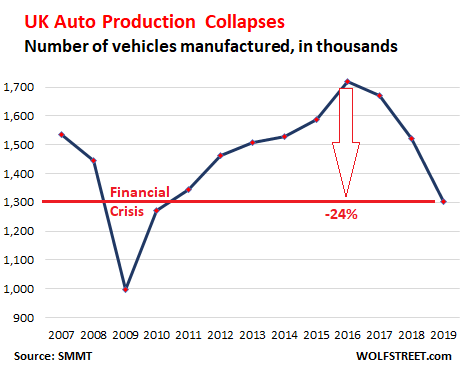
Why Has UK Auto Manufacturing Collapsed 24% in Three Years?

81% of the vehicles are exported; they can be built anywhere. Honda is leaving. Nissan may be too. Vauxhall may be shuttered. Jaguar Land Rover offshored some production. But EV production soared.

Auto production in the UK slumped by 14.2% in 2019 to 1.3 million units, the lowest since 2010 when the industry was grappling with the fallout of the Global Financial Crisis. Five years ago, UK car production was growing and on target to hit 2 million units a year by 2020, beating the record set in 1972. Instead, it has slumped for the past three years in a row, in total by 24% since 2016, according to the industry group, the Society of Motor Manufacturers and Traders (SMMT):

How important is auto manufacturing in the UK’s total manufacturing sector? According to the SMMT, automakers in the UK employ 168,000 people (1 in 14 of total manufacturing employment). Automakers also support an additional 279,000 jobs in the UK. Annual salaries are typically 21% higher than the average across all UK employment. And “in regions such as the North East and West Midlands, automotive accounts for more than one in six manufacturing jobs.”

The industry faces a litany of problems, including the broad, ongoing shift away from diesel across Europe, shifting production to other countries, significant model production changes, low confidence in the UK economy, sliding demand at home and overseas, and Brexit-related issues.

81% of the vehicles are exported; they can be built anywhere.

Production for domestic sales dropped 12.3% in 2019, to 247,000 vehicles. Production for export dropped by 14.7% to 1.056 million vehicles, with overseas orders still accounting for 81% of the vehicles assembled in UK plants.

The manufacturers with the sharpest production declines in 2019 compared to 2018, were:

  • Honda: -32%
  • Nissan, the second largest car manufacturer in UK: -21%
  • Vauxhall (UK’s Opel, subsidiary of French automaker PSA): -20%
  • Jaguar Land Rover (JLR), UK’s largest car manufacturer: -14.5%.

Honda and Nissan have plants around the world and can build vehicles anywhere.

Even JLR has plants in multiple countries, including in the EU (Slovakia), India, China (joint venture with state-owned Chery Automobiles), and Brazil. In 2018, JLR shifted production of its Land Rover Defender from the the UK to its assembly plant in Slovakia, where it cashed in €125 million of investment aid from the Slovakian government.

Continue reading the article on Wolf Street